Comment l’altitude, le sol et le climat façonnent les profils aromatiques du café
Publié par SpecialityCoffee.ca

Introduction : L'arôme du café se développe bien avant la torréfaction
L'arôme du café ne se crée pas uniquement lors de la torréfaction. Bien avant la torréfaction ou l'infusion, il se forge à l'origine grâce à l'altitude, la composition du sol, le climat et les conditions de culture . Ces facteurs environnementaux constituent ce que l'on appelle le terroir , concept également utilisé en vin pour expliquer pourquoi les raisins de différentes régions ont des saveurs distinctes.
Comprendre comment l'altitude, le sol et le climat affectent la saveur du café aide les consommateurs à faire des choix plus éclairés et explique pourquoi le café de spécialité a un goût si différent du café ordinaire.
Qu'est-ce que le terroir dans le café ?
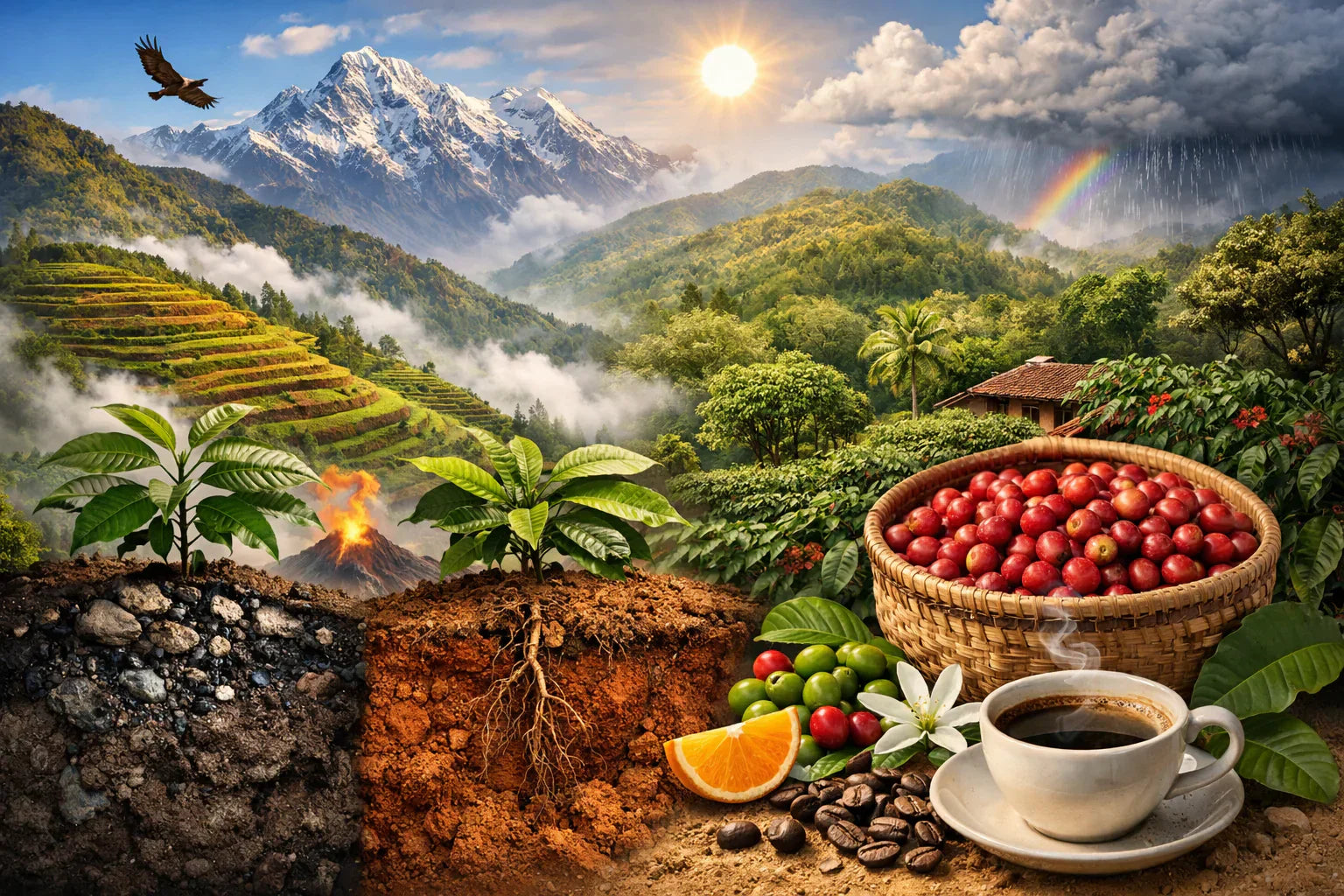
Le terroir désigne l'environnement naturel dans lequel le café est cultivé. Il comprend :
- Élévation
- Chimie des sols
- Régimes de précipitations
- Plages de températures
- Exposition au soleil
Dans le café de spécialité, le terroir est mis en valeur plutôt que neutralisé. Une torréfaction de haute qualité préserve ces caractéristiques au lieu de les masquer.
Comment l'altitude influence le goût du café
Maturation plus lente des cerises
En altitude, les températures plus fraîches ralentissent le développement des cerises de café. Cette maturation prolongée permet aux grains de :
- Développer des sucres plus complexes
- Devenir plus dense
- Produire une acidité plus vive
Plages d'altitude typiques
- Basse altitude (en dessous de 1 200 m) : corps plus lourd, acidité atténuée
- Altitude moyenne (1 200–1 600 m) : douceur équilibrée
- Haute altitude (1 800 m+) : acidité vive, arômes complexes
Influence aromatique du café de haute altitude
Les cafés cultivés en altitude présentent souvent les caractéristiques suivantes :
- acidité des agrumes ou des fruits à noyau
- arômes floraux
- finitions propres et structurées
C’est pourquoi de nombreux cafés parmi les plus prisés au monde proviennent de hautes altitudes.
Le rôle du sol dans l'arôme du café
sol volcanique
Présent dans des régions comme l'Éthiopie, le Guatemala et le Costa Rica, le sol volcanique est riche en minéraux et contribue à :
- Douceur accrue
- Acidité propre
- Complexité liée aux minéraux
Sol riche en argile
Les sols argileux retiennent l'eau et les nutriments, produisant souvent des cafés aux caractéristiques suivantes :
- Corps plus rond
- une douceur plus profonde
- Des notes chocolatées ou de noisette
Drainage du sol et santé des racines
Un sol bien drainé prévient le stress racinaire et permet aux plants de café d'absorber efficacement les nutriments, ce qui donne des plants plus sains et une meilleure qualité en tasse.
Climat : L’équilibre délicat dont le café a besoin
Le caféier prospère dans une fenêtre climatique étroite.
Température
Le café Arabica pousse de façon optimale entre 18 et 22 °C . Une chaleur excessive accélère le développement des cerises, réduisant ainsi leur douceur et leur complexité.
Précipitations
Des précipitations équilibrées sont essentielles :
- Une quantité insuffisante provoque le stress des plantes
- Un excès entraîne des maladies et une fermentation irrégulière.
Les régimes pluviométriques saisonniers influencent fortement la qualité des récoltes.
Comment les microclimats créent des profils de saveur uniques
Même au sein d'une même région, les microclimats peuvent varier considérablement en raison de :
- Couverture d'ombrage
- exposition au vent
- Positionnement dans la vallée
- Orientation solaire
Ces différences expliquent pourquoi deux exploitations situées à seulement quelques kilomètres de distance peuvent produire des cafés très différents.
Changement climatique et avenir de l'arôme du café
Le changement climatique représente un défi majeur pour le café de spécialité :
- La hausse des températures réduit les zones propices à la culture.
- Les pluies imprévisibles perturbent les cycles de récolte
- L'augmentation des ravageurs et des maladies menace la qualité
Par conséquent, les producteurs de café sont :
- Se déplacer vers des altitudes plus élevées
- Expérimenter de nouvelles variétés
- Ajustement des méthodes de traitement
Les consommateurs pourraient constater une plus grande variété — et une plus grande rareté — à l'avenir.
Pourquoi une torréfaction de haute qualité préserve le terroir
La torréfaction peut soit :
- Révéler les caractéristiques d'origine, ou
- Masquez-les entièrement
Les torréfacteurs spécialisés torréfient généralement plus légèrement pour préserver :
- Acidité
- Douceur
- Clarté d'origine
La torréfaction excessive efface le terroir, ce qui rend les différents cafés similaires en termes de goût.
Comment la préparation influence l'expression du terroir
La méthode de préparation influence la perception du terroir :
- Le café filtre met l'accent sur la clarté et l'acidité.
- L'espresso concentre la douceur et la structure
- La cafetière à piston améliore le corps et la texture en bouche.
Une mouture et une extraction appropriées sont essentielles pour exprimer le caractère d'origine.
Comment choisir son café en fonction de ses préférences de terroir
Choisissez les cafés d'altitude si vous appréciez :
- Acidité vive
- notes florales et fruitées
- finitions propres
Choisissez des cafés de plus basse altitude si vous préférez :
- saveurs chocolatées
- Corps plus rond
- Acidité plus faible
Comprendre le terroir vous permet d'acheter du café de manière intentionnelle plutôt qu'au hasard.
En conclusion : le terroir est l’âme du café de spécialité
L'altitude, le sol et le climat façonnent le café bien avant qu'il n'arrive dans votre tasse. Le café de spécialité met en valeur ces différences naturelles au lieu de les gommer.
Choisir un café de spécialité, c'est goûter à la géographie, au climat et au savoir-faire , et pas seulement à la caféine.