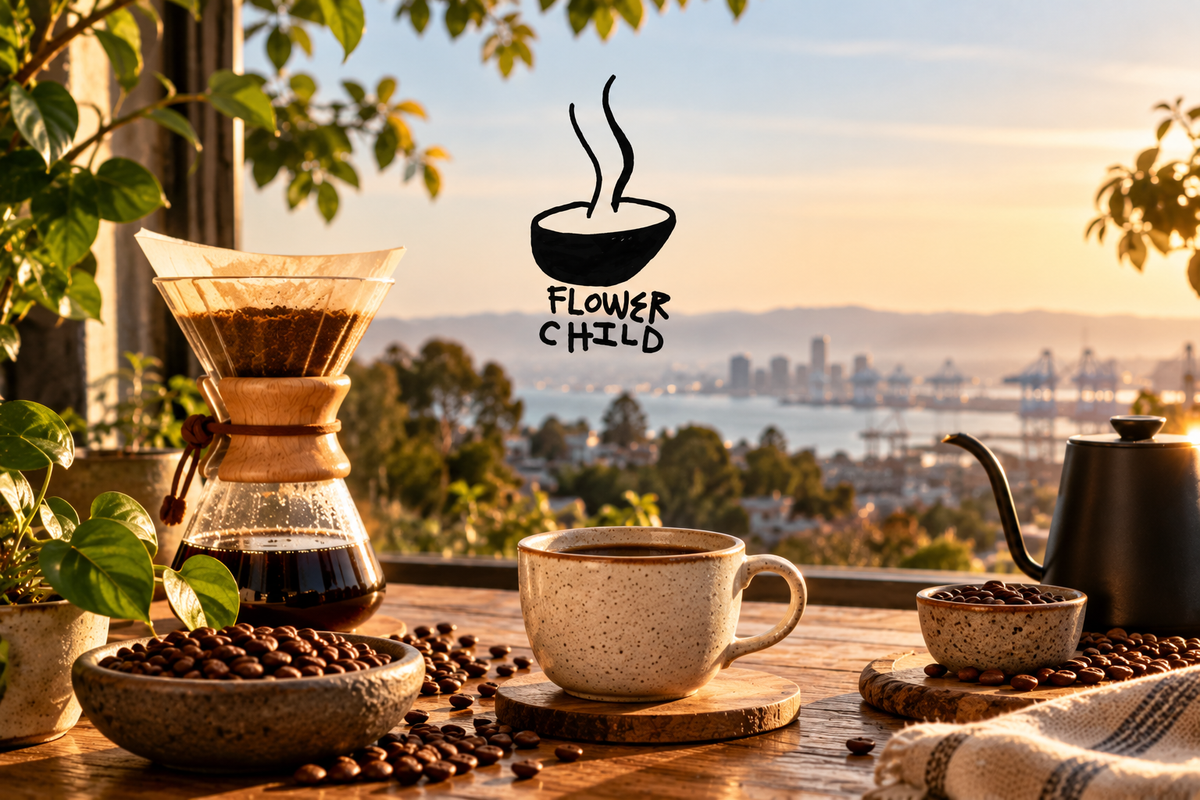
Flower Child Coffee: The Oakland Roaster Celebrating Variety, Terroir & Light Roasting
Specialty coffee is often at its most fascinating when a roaster gives you a chance to understand just how different coffee can be.
The same species can produce dramatically different flavours depending on its variety, growing region, elevation, climate, processing method, producer, and roasting approach. For Flower Child Coffee, exploring those differences is at the heart of the project.
Based in Oakland, California, Flower Child Coffee is an independent specialty coffee roaster founded by Prestin. Rather than building its identity around a single origin or signature blend, Flower Child focuses on showcasing the diversity of coffee itself — particularly the characteristics created by different cultivars, producers and terroirs.
The roaster describes its coffees as fully developed light roasts, with profiles designed to provide a clear expression of the harvest, terroir and variety. Every coffee is repeatedly analyzed, cupped and fine-tuned rather than being treated with a standardized roasting approach.
That philosophy makes Flower Child particularly interesting for coffee drinkers who enjoy discovering what makes one coffee different from another.
At Speciality Coffee, we're excited to introduce Flower Child Coffee and its evolving selection of coffees to Canadian specialty coffee drinkers.
Explore the Flower Child Coffee collection at Speciality Coffee
For more coffee guides, roaster profiles and specialty coffee stories, visit our All About Speciality Coffee Blog.
The Story Behind Flower Child Coffee
Flower Child Coffee began with a desire to explore the far reaches of coffee quality.
Founder and roaster Prestin describes the project as an opportunity to explore the enormous diversity found across coffee-growing regions and varieties. Rather than treating coffee as a standardized agricultural product, Flower Child looks closely at the characteristics that make individual coffees unique.
That means paying attention to the details.
A coffee's cultivar can influence its potential in the cup. Its growing region and terroir contribute another layer of character. Processing can dramatically change sweetness, acidity, body and aromatic expression, while roasting determines how those qualities ultimately appear when brewed.
Flower Child's selection is built around this idea of discovery.
The roaster specifically seeks coffees that can demonstrate the potential of their varieties and growing regions. According to Flower Child, one of its greatest pleasures is experiencing how the same or similar varieties can taste remarkably different when grown in different places.
That makes every new release part of a larger exploration.
Instead of simply asking whether a coffee tastes “good,” Flower Child's approach asks another question:
What makes this coffee itself?
A Roasting Philosophy Built Around Clarity
Flower Child Coffee describes its coffees as fully developed light roasts.
The distinction is important.
Light roasting isn't simply about stopping the roast early. A carefully developed light roast requires the roaster to balance development with the characteristics of the green coffee so that the final cup remains sweet, clear and expressive.
Flower Child approaches each coffee individually.
Its roasting profiles are crafted to transparently showcase the harvest, terroir and varietal characteristics, and the roaster says it continually analyzes, cups and fine-tunes its approach to each coffee.
This creates a style where the roasting process is intended to support the green coffee rather than overwhelm it.
For coffee drinkers, that can mean more opportunity to experience distinctions between coffees.
An Ethiopian landrace coffee may emphasize floral or citrus characteristics. A Kenyan lot can show vibrant acidity and fruit. A Colombian variety may reveal completely different combinations of sweetness, fruit and structure.
The roast is part of the experience, but it isn't intended to become the entire experience.
Why Variety Matters at Flower Child Coffee
One of Flower Child's defining interests is the diversity of coffee varieties.
Coffee varieties can have a major influence on the potential flavour and structure of a coffee, and specialty coffee producers around the world increasingly dedicate individual lots to specific cultivars.
Flower Child's current and past selections demonstrate that interest.
Its catalogue includes varieties and lots such as Pacamara, Chiroso, Gesha, Sidra, Pink Bourbon, SL28, Mejorado and different landrace coffees, among many others.
This is particularly exciting for enthusiasts who want to explore coffee beyond simply knowing its country of origin.
Two coffees from Colombia can taste completely different.
Two Ethiopian coffees can taste completely different.
Even the same variety can express itself differently depending on where and how it is grown.
Flower Child's philosophy is essentially an invitation to explore those differences rather than flattening them into a single roast style or flavour profile.
Working Closely With Coffee Producers
The relationship between roaster and producer is another important part of Flower Child's philosophy.
The company says its coffees come from highly skilled farmers who put significant effort into producing exceptional lots. Flower Child also emphasizes maintaining close relationships with producers and paying them well, including higher premiums intended to support the livelihoods and future development of its producing partners and the wider supply chain.
This relationship-driven approach matters because specialty coffee is ultimately a collaborative process.
The producer determines much of what is possible in the coffee through variety selection, agricultural practices, harvesting and processing.
The roaster then works to understand those decisions and translate the green coffee's potential through roasting.
When communication between producer and roaster improves, both sides can learn more about what works.
Flower Child describes its producer relationships as crucial to establishing the quality standard it offers, while also noting that the dialogue between farmers and roasters has become increasingly constructive and insightful over time.
Seasonality Is Central to the Flower Child Experience
Coffee is an agricultural product, which means freshness and seasonality matter.
Flower Child explicitly describes its roasting approach as being focused on showcasing coffees as seasonally fresh as possible.
The company also follows a regular weekly roasting schedule, with roasting on Mondays and shipping on Tuesdays. Customers ordering by Sunday are scheduled for the following Monday's roast.
That schedule reflects an important part of specialty coffee culture: coffee changes.
Harvests arrive, lots sell through, and new coffees replace them.
Flower Child's catalogue reflects that reality. Its archive contains a large range of previous releases, while its active coffee collection is much smaller and currently focuses on a selection of seasonal coffees.
For coffee enthusiasts, this makes following Flower Child releases part of the fun.
A coffee you discover today may not be available forever.
The next release may come from a completely different producer, country or variety.
What Makes Flower Child Coffee Different?
1. A Focus on Coffee Variety
Flower Child is deeply interested in cultivars and the differences they can produce from one region to another.
Its selection isn't simply organized around familiar origins. Varieties and producers are central to the story.
2. Fully Developed Light Roasts
Flower Child's coffees are roasted as fully developed light roasts intended to showcase the harvest, terroir and varietal character.
The goal is clarity without sacrificing development.
3. Producer Relationships
Flower Child emphasizes direct dialogue with producers and says it pays premium prices to support producing partners and the wider supply chain.
4. Seasonal Selection
The coffee menu evolves with availability and harvest cycles rather than remaining completely static.
5. A Curiosity-Driven Approach
Perhaps the defining characteristic of Flower Child is curiosity.
The roaster isn't simply searching for one particular flavour profile.
It's interested in seeing how different cultivars, regions, producers and processing methods express themselves.
What Can You Expect in the Cup?
Flower Child's range is broad, so there isn't one universal flavour profile.
That said, the focus on clean, vibrant and character-driven coffees means that the individual qualities of each lot are central to the experience. Flower Child describes its coffee collection as being curated for cleanliness, vibrancy and exemplary character.
The current selection at Speciality Coffee demonstrates that variety.
The Mario Mejía Pacamara from La Paz, Honduras, for example, is a washed coffee grown at 1,650 metres. Flower Child describes the cup with agave, lemongrass and elderberry, while the detailed profile highlights lemony brightness, sweet pepper, agave-like sweetness and wild berry character.
Other current Flower Child coffees include selections such as Edgar Gonzalez Chiroso, Danche, Kiamugumo and Decaf Divino, giving drinkers several different directions to explore.
This variety is precisely what makes the roaster interesting.
If you're looking for a single “house flavour,” Flower Child may not be the obvious destination.
If you want to understand the differences between coffees, however, there is plenty to discover.
Mario Mejía: A Look at Flower Child's Approach
One current example provides a useful window into the kind of coffee Flower Child seeks.
Mario Mejía's Pacamara comes from La Paz, Honduras, at 1,650 metres and is washed. The coffee was harvested in March 2026 and is described with notes of agave, lemongrass and elderberry.
The producer story is equally interesting.
Mario Samuel Mejía is an agronomist and represents a newer generation of specialty coffee producers in Honduras. At 26, he took over Finca El Jardin from his father and began developing a specialty coffee program in his region in 2019. In 2023, he built a wet mill at the farm and began providing wet-mill services to other producers participating in the program.
The coffee itself undergoes hand selection, depulping, approximately 50–70 hours of wet fermentation, washing and drying on African beds. Because of the region's cold climate and elevation, drying can take approximately 15–30 days depending on weather and process.
It's a good illustration of why Flower Child's focus extends beyond roasting.
The finished cup is the result of variety, farm, altitude, processing, producer decisions and roasting all working together.
How to Brew Flower Child Coffee
Flower Child's light-roasted coffees are particularly well suited to brewing methods that allow their aromatic and flavour characteristics to remain clear.
Pour-over is an obvious place to start.
A V60, Kalita Wave or similar brewer can provide the clarity needed to explore acidity, sweetness and fruit characteristics.
AeroPress can also be a useful option when you want to experiment with body and extraction while maintaining plenty of flavour clarity.
For coffees with more intense fruit or fermentation character, a clean filter recipe can help reveal the complexity without making the cup unnecessarily heavy.
As always, the specific coffee should determine the final recipe.
Start with a sensible coffee-to-water ratio, use fresh water and adjust grind size according to taste. If the coffee tastes sharp and underdeveloped, a slightly finer grind or longer extraction may help. If it tastes dry or overly intense, try reducing extraction.
The goal is to discover what the coffee has to offer.
Why We Selected Flower Child Coffee for Speciality Coffee
At Speciality Coffee, we look for roasters with a clear identity.
Flower Child Coffee has one.
Its philosophy is built around discovering the diversity of coffee: different varieties, different producers, different growing regions and different harvests.
That makes the roaster a natural fit for specialty coffee drinkers who want to explore rather than simply settle into one familiar flavour profile.
The focus on fully developed light roasting also makes the coffees particularly interesting for people who enjoy clarity and origin expression, while the constantly changing selection creates opportunities to discover something new with each release.
Most importantly, Flower Child keeps the producer at the center of the story.
The farm, variety, terroir and processing are not secondary details.
They are the foundation of the coffee.
And the role of roasting is to reveal them.
Discover Flower Child Coffee at Speciality Coffee
From its Oakland base, Flower Child Coffee offers a constantly evolving look at what specialty coffee can be.
Its approach is simple in concept but broad in possibility: find exceptional coffees, understand their unique characteristics, roast them with precision, and share what makes each one special.
That could mean a washed Pacamara from Honduras.
A Chiroso from Colombia.
A Kenyan SL28.
An Ethiopian landrace.
A Gesha.
Or something completely different in the next season.
For coffee lovers, that's the appeal.
There is always another variety to discover, another producer to learn about and another expression of coffee waiting to be brewed.
Explore Flower Child Coffee at Speciality Coffee
And if you want to keep exploring specialty coffee roasters, origins, processing methods and brewing techniques, visit our All About Speciality Coffee Blog.
Frequently Asked Questions About Flower Child Coffee
1. What is Flower Child Coffee?
Flower Child Coffee is an independent specialty coffee roaster based in Oakland, California. The company focuses on clean, expressive coffees and the distinctive characteristics of varieties, producers and growing regions.
2. Who founded Flower Child Coffee?
Flower Child Coffee was founded by Prestin, who serves as the company's roaster and founder.
3. Where is Flower Child Coffee located?
Flower Child Coffee is based in Oakland, California.
4. What roast style does Flower Child Coffee use?
Flower Child describes its coffees as fully developed light roasts, with profiles designed to express the harvest, terroir and varietal characteristics of each coffee.
5. Does Flower Child Coffee work directly with producers?
Flower Child emphasizes close relationships and dialogue with its producing partners and says it pays premium prices to support farmers and the wider supply chain.
6. What kind of coffee does Flower Child Coffee offer?
The selection changes seasonally and includes coffees from regions such as Ethiopia, Kenya, Colombia and Honduras, with varieties including Chiroso, Gesha, Pacamara, SL28 and landrace coffees.
7. Is Flower Child Coffee good for pour-over?
Its fully developed light-roasted coffees can be well suited to pour-over brewing, particularly when the goal is to highlight clarity, acidity, sweetness and aromatic detail.
8. Where can I buy Flower Child Coffee in Canada?
You can explore the current Flower Child Coffee selection through Speciality Coffee, including coffees such as Mario Mejía Pacamara, Edgar Gonzalez Chiroso, Danche, Kiamugumo and Decaf Divino.