

Dégustation de café : pratiquer le cupping à la maison
Publié par SpecialityCoffee.ca
Introduction : Qu’est-ce que la dégustation de café (et pourquoi c’est important) ?
La dégustation à la tasse est la méthode standardisée utilisée par les professionnels du café du monde entier pour évaluer la qualité, comparer les cafés et prendre des décisions d'achat. Bien qu'elle puisse paraître technique ou intimidante, la dégustation à la tasse est en réalité la méthode la plus authentique et la plus sincère pour déguster un café .
Contrairement aux méthodes d'infusion qui introduisent des variables telles que les filtres, la pression ou la technique, la dégustation à la tasse élimine la complexité. Elle permet au café lui-même — son origine, son traitement et sa torréfaction — de s'exprimer pleinement.
Pour les amateurs de café à domicile, apprendre à déguster le café est l'un des moyens les plus rapides de :
- Comprendre les différences de saveur
- Améliorer les décisions d'achat
- Développer votre palais
- Mieux apprécier le café de spécialité
Qu'est-ce que la dégustation de café ?
La dégustation de café est un processus de dégustation contrôlé où le café moulu est infusé directement dans l'eau chaude, sans agitation ni filtration. Après l'infusion, la croûte de mouture est brisée, les arômes sont évalués et le café est dégusté à la cuillère.
La dégustation à la tasse est utilisée pour :
- Évaluer la qualité du café vert
- Comparer les profils de torréfaction
- Identifier les défauts
- Décrire les notes aromatiques de manière cohérente
Sa simplicité est volontaire afin de ne pas masquer le caractère du café .
Pourquoi la dégustation à la tasse est différente de l'infusion
Les méthodes de préparation traditionnelles influencent l'extraction par :
- Taille de la mouture
- Débit d'eau
- Type de filtre
- Pression
- Temps d'infusion
La dégustation à la tasse élimine ces variables. Chaque café est :
- Moulu de la même manière
- Infusé de la même manière
- Dégusté de la même manière
Cela rend la dégustation à la tasse idéale pour une comparaison objective .
Qui utilise la dégustation de café ?
La dégustation de café est utilisée par :
- producteurs de café
- acheteurs de café vert
- Torréfacteurs
- équipes de contrôle de la qualité
- Juges du concours
- consommateurs avertis
Ces dernières années, la dégustation à la tasse est devenue plus accessible aux amateurs de café à domicile qui souhaitent approfondir leurs connaissances.
Ce dont vous avez besoin pour préparer du café à la maison
Vous n'avez pas besoin d'équipement professionnel pour commencer.
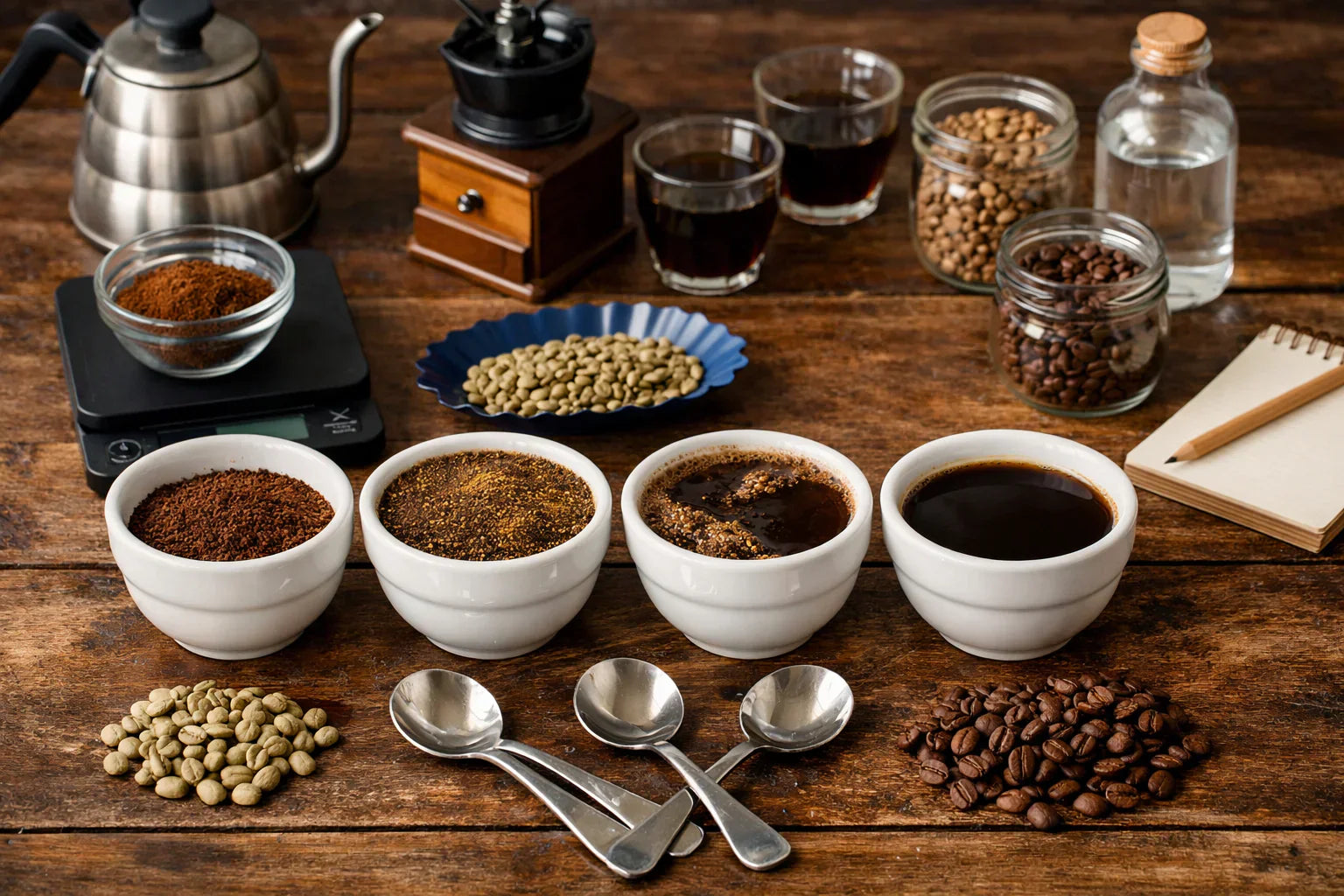
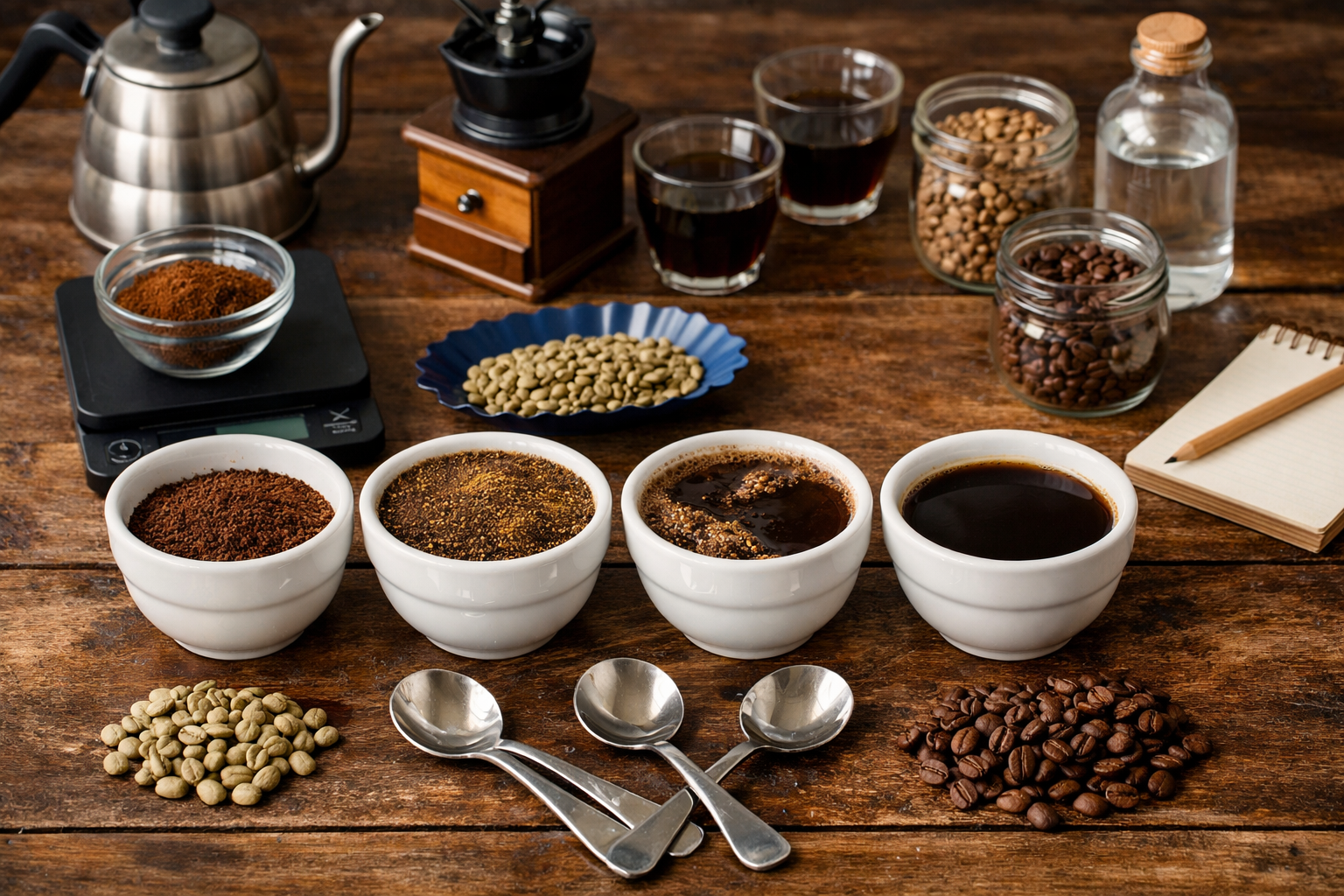
Équipement de base
- Café en grains fraîchement torréfié
- Moulin à meules
- Balance
- Bouilloire
- Bols ou tasses (identiques si possible)
- Cuillères à soupe ou cuillères de dégustation
- Minuteur
Facultatif, mais utile
- Carnet de dégustation
- Roue des saveurs
- Eau filtrée
La constance compte plus que la perfection.
Rapport café/eau pour la dégustation
Le ratio classique de dégustation est :
8,25 grammes de café pour 150 ml d'eau
Ce ratio garantit une extraction équilibrée et homogène entre les échantillons.
Utilisez le même ratio pour chaque tasse de café.
Étape par étape : Comment préparer une tasse de café à la maison
Étape 1 : Moudre le café
Moudre le café légèrement plus grossièrement que pour la méthode par infusion manuelle, comme du sable grossier.
Sentez immédiatement le café fraîchement moulu et notez :
- Floral
- Fruité
- Notes de fruits à coque
- Chocolaté
- Épicé
L'arôme sec donne des indices précoces sur la qualité et la fraîcheur.
Étape 2 : Ajouter de l'eau chaude
Chauffer l'eau à environ 93–96°C (200–205°F) .
Versez de l'eau directement sur le café moulu jusqu'à ce que le bol soit plein.
Démarrez le chronomètre.
Ne pas remuer.
Étape 3 : Sentir la croûte (après 4 minutes)
Au bout de quatre minutes, une croûte de mouture se forme à la surface.
Approchez-vous et humez profondément. Ce moment révèle souvent :
- Arômes maximaux
- Douceur
- Notes de fermentation
- Défauts potentiels
Étape 4 : Casser la croûte
À l'aide d'une cuillère, cassez délicatement la croûte en la repoussant de vous tout en inspirant.
C'est l'un des moments les plus aromatiques de la séance de dégustation.
Après avoir cassé la croûte, retirez la mousse et les particules de mouture qui restent à la surface.
Étape 5 : Laisser refroidir le café
Attendez encore 5 à 10 minutes.
Le goût du café varie selon sa température. La dégustation à la tasse consiste à apprécier le café tout au long de sa courbe de refroidissement , ce qui permet de mieux révéler son équilibre et ses défauts.
Étape 6 : Goûtez le café
À l'aide d'une cuillère, aspirez le café avec force pour le répartir sur votre palais.
Cette aération permet aux arômes d'atteindre votre nez et améliore la perception.
Goûtez-le plusieurs fois à mesure qu'il refroidit.
Que faut-il évaluer lors d'une dégustation de café ?
Arôme
- Propre ou terne ?
- Expressif ou discret ?
Acidité
- Lumineux et agréable ?
- Acidulé ou piquant ?
Douceur
- Comme du miel ?
- Sucre brun ?
- Absent?
Corps
- Léger et semblable à du thé ?
- Crémeux?
- Lourd?
Saveur
- Clair et distinct ?
- Boueux ou confus ?
Arrière-goût
- Propre et persistant ?
- Amer ou asséchant ?
Comment identifier la qualité lors d'une séance de dégustation ?
Un café de haute qualité présente généralement les caractéristiques suivantes :
- Arôme propre et agréable
- Douceur naturelle
- Acidité équilibrée
- notes aromatiques claires
- Pas d’amertume désagréable
Un café de mauvaise qualité ou défectueux peut avoir le goût suivant :
- Astringent
- phénolique
- Plat
- Acide ou amer simultanément
La dégustation à la tasse révèle les défauts.
Défauts courants du café que vous pourriez rencontrer
- Fermentation : goût vinaigré, acide
- Phénol : médicinal, plastique
- Cuit au four : fade, sans vie
- Fumé : caractère torréfié excessif
Identifier les défauts améliore la confiance des acheteurs.
Comparaison côte à côte des cafés
Déguster plusieurs cafés simultanément est la méthode d'apprentissage la plus efficace.
Essayez de comparer :
- Origines différentes
- Traitement lavé vs traitement naturel
- Torréfaction légère ou moyenne
- Deux régions éthiopiennes
Les différences deviennent beaucoup plus évidentes lorsqu'on les goûte ensemble.
Prendre des notes sans trop réfléchir
Vous n'avez pas besoin de vocabulaire sophistiqué.
Des descripteurs simples fonctionnent :
- Doux
- Brillant
- Fruité
- Net
- Lourd
- Amer
Avec le temps, votre vocabulaire s'enrichira naturellement.
Pourquoi la dégustation améliore la préparation quotidienne
La dégustation à la tasse entraîne votre palais à reconnaître :
- Douceur
- Équilibre
- Problèmes d'extraction
Cela vous permet de mieux régler la mouture, le ratio d'infusion et la température de l'eau à la maison.
Pourquoi le café de spécialité est idéal pour la dégustation
Le café de spécialité est :
- Exempt de défauts majeurs
- Fraîchement torréfié
- Une origine clairement indiquée
Cela permet de mieux percevoir les nuances et de comprendre pourquoi les cafés diffèrent.
En conclusion : la dégustation est la méthode la plus rapide pour apprendre à reconnaître le café.
Il n’est pas nécessaire de devenir professionnel pour bénéficier de l’intérêt de la dégustation. Même une pratique occasionnelle à domicile améliore considérablement votre capacité à :
- Comparer les cafés avec méthode
- Choisir ses cafés en connaissance de cause
- Préparer un meilleur café
La dégustation transforme le café d'une habitude en une compétence, et rend chaque tasse plus gratifiante.

%20?%0ALa%20d%C3%A9gustation%20%C3%A0%20la%20tasse%20est%20la%C2%A0m%C3%A9thode%20standardis%C3%A9e%C2%A0utilis%C3%A9e%20par%20les%20profes...)