Le guide ultime de la torréfaction du café : du grain vert au sachet
Publié par SpecialityCoffee.ca
Introduction : Pourquoi la torréfaction du café est plus importante que la plupart des gens ne le pensent
La torréfaction est l'étape cruciale qui révèle les arômes du café. Les grains de café vert recèlent un potentiel brut de douceur, d'acidité et d'arôme, mais c'est le processus de torréfaction qui détermine comment ces caractéristiques s'expriment en tasse . Deux cafés provenant d'une même plantation peuvent avoir un goût totalement différent selon leur mode de torréfaction.
Pour les amateurs de café de spécialité, comprendre la torréfaction est essentiel. Cela explique pourquoi certains cafés ont un goût vif et floral, d'autres riches et chocolatés, et pourquoi le degré de torréfaction ne suffit pas à définir la qualité.
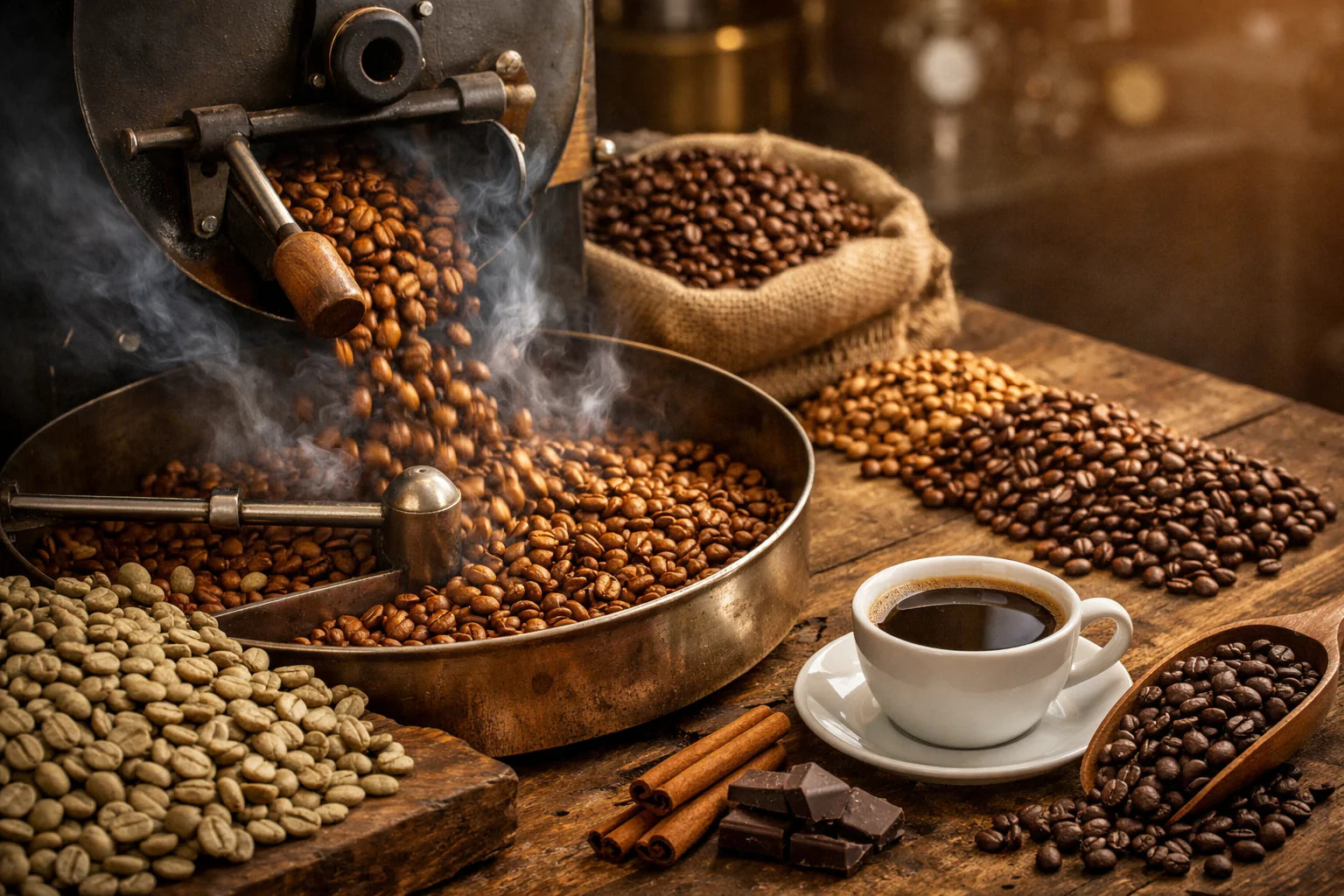
Ce guide décrit l' intégralité du processus de torréfaction du café , du grain vert au sachet fini, et explique comment les choix de torréfaction influencent la saveur, le corps et l'équilibre.
Qu'est-ce que le café vert ?
Le café vert est la graine crue et non torréfiée de la cerise de café. À ce stade, le café :
- Odeur herbacée ou végétale
- Ne contient aucun arôme de café perceptible
- Peut être conservé pendant des mois dans des conditions appropriées
La qualité du café vert est influencée par :
- Origine et altitude
- Variété
- Méthode de traitement
- pratiques de récolte et de séchage
La torréfaction ne crée pas la qualité — elle révèle ou détruit ce qui existe déjà dans le grain vert.
L'objectif de la torréfaction du café
Le but de la torréfaction est de :
- Développer les sucres
- Réduire les notes crues et végétales
- Créer des composés aromatiques
- Équilibrer l'acidité, la douceur et l'amertume
Une bonne torréfaction met en valeur les caractéristiques intrinsèques. Une mauvaise torréfaction masque les défauts ou domine la saveur par une intensité excessive.
Les trois principales étapes de la torréfaction du café
1. Phase de séchage
Lors de la première étape, l'humidité s'évapore des grains.
Caractéristiques principales :
- Les grains passent du vert au jaune.
- Les arômes herbacés dominent
- Aucun développement de saveur pour le moment
Si cette étape est trop rapide, cela peut entraîner un séchage inégal et des défauts de développement par la suite.
2. Réaction de Maillard
C'est à ce stade que commence la majeure partie du développement des arômes.
Ce qui se produit:
- Les sucres et les acides aminés réagissent
- Le brunissement se produit
- Des arômes de pain, de caramel et de noix se dégagent.
La réaction de Maillard est responsable de la douceur, du corps et de la complexité .
3. Phase de développement
Cette dernière étape détermine le niveau de torréfaction.
Facteurs clés :
- Durée du développement
- progression de la température
- Vitesse d'application de la chaleur
Un développement insuffisant donne un café acide et sous-développé. Un développement excessif donne un café amer et aux arômes fades.
Explication de la première et de la deuxième craquement
Premier craquement
- Les grains gonflent et craquent bruyamment
- La vapeur d'eau s'échappe
- Le café devient buvable
La plupart des torréfactions de café de spécialité s'achèvent après le premier craquement , préservant ainsi les caractéristiques d'origine.
Deuxième craquement
- Les parois cellulaires se désagrègent
- Les huiles migrent à la surface
- Les saveurs torréfiées dominent.
Les torréfactions foncées atteignent ou dépassent généralement la deuxième craquement, ce qui réduit la clarté de l'origine.
Comprendre les niveaux de torréfaction (légère, moyenne, foncée)
Torréfaction légère
Caractéristiques:
- Acidité vive
- Saveurs florales et fruitées
- Complexité perçue plus élevée
Idéal pour :
- Cafés d'origine unique
- Infusion par filtration et par méthode douce
Les torréfactions légères révèlent le mieux le terroir.
Torréfaction moyenne
Caractéristiques:
- Acidité et douceur équilibrées
- notes de sucre caramélisé
- Un attrait plus large
Idéal pour :
- Préparation polyvalente
- Les consommateurs qui se tournent vers le café de spécialité
Les torréfactions moyennes font le lien entre l'origine et le caractère de la torréfaction.
Torréfaction foncée
Caractéristiques:
- Acidité plus faible
- Saveurs amères et fumées
- Corps plus lourd
Idéal pour :
- préférences gustatives traditionnelles
- Boissons à base de lait
La torréfaction poussée masque l'origine et accentue l'intensité de la torréfaction.
Pourquoi les torréfacteurs spécialisés préfèrent les torréfactions légères
Les torréfacteurs spécialisés torréfient généralement plus légèrement car :
- Le café vert de haute qualité n'a pas besoin d'être caché.
- Les torréfactions plus légères préservent l'acidité et la douceur.
- La clarté des saveurs s'améliore
- Les récits d'origine restent intacts
La torréfaction légère n'est pas une question de mode, c'est une question d'honnêteté et de précision .
Comment le niveau de torréfaction influence la préparation
Influence du niveau de torréfaction :
- Solubilité
- exigences relatives à la taille de la mouture
- Comportement d'extraction
Torréfactions légères :
- Nécessite un broyage plus fin
- Bénéficiez de températures d'eau plus élevées
- Extraction précise nécessaire
Torréfaction foncée :
- Extraire plus facilement
- Nécessite un broyage plus grossier
- Goût amer en cas de sur-extraction
Comprendre le niveau de torréfaction vous aide à préparer une infusion plus efficace.
Défauts de torréfaction courants (et leur goût)
Sous-développement
- Aigre
- Pain
- Creux
Développement excessif
- Amer
- Plat
- notes de sucre brûlé
Pâtisserie
- Saveurs fades et sans vie
- Manque de douceur
Une torréfaction de haute qualité permet d'éviter ces défauts grâce à une application contrôlée de la chaleur.
Profils de torréfaction et consistance
Un profil de torréfaction est un plan enregistré indiquant :
- Temps
- Température
- Taux d'augmentation
La cohérence est importante car les clients s'attendent à :
- Saveur reproductible
- Comportement prévisible en matière de préparation
- Qualité fiable
Les torréfacteurs professionnels s'appuient sur le profilage pour garantir la constance sans sacrifier la fraîcheur.
Date de torréfaction vs Date limite de consommation
Le café de spécialité privilégie la date de torréfaction , et non la date de péremption.
Directives générales :
- Saveur optimale : 5 à 28 jours après la torréfaction
- L'espresso bénéficie souvent d'un temps de repos.
- Le café ne se périme pas rapidement, mais il devient rassis.
La fraîcheur est un indicateur de qualité essentiel.
La place de la torréfaction dans l'éthique du café de spécialité
Respects pour la torréfaction :
- Le travail du fermier
- L'origine du café
- L'expérience du consommateur
La torréfaction excessive d'un café de haute qualité gaspille son potentiel et nuit à la transparence.
En conclusion : la torréfaction révèle tout son potentiel et donne naissance à de véritables saveurs.
La torréfaction du café est à la fois une science et un art. Bien réalisée, elle :
- Préserve la douceur
- Accroît la complexité
- Points saillants de l'origine
- Crée un équilibre
Comprendre la torréfaction vous aide à choisir un meilleur café, à l'infuser avec plus d'assurance et à apprécier pourquoi le café de spécialité a un goût différent de tous les autres.