

Why Does Caffeine Keep You Awake? Effects & Sleep
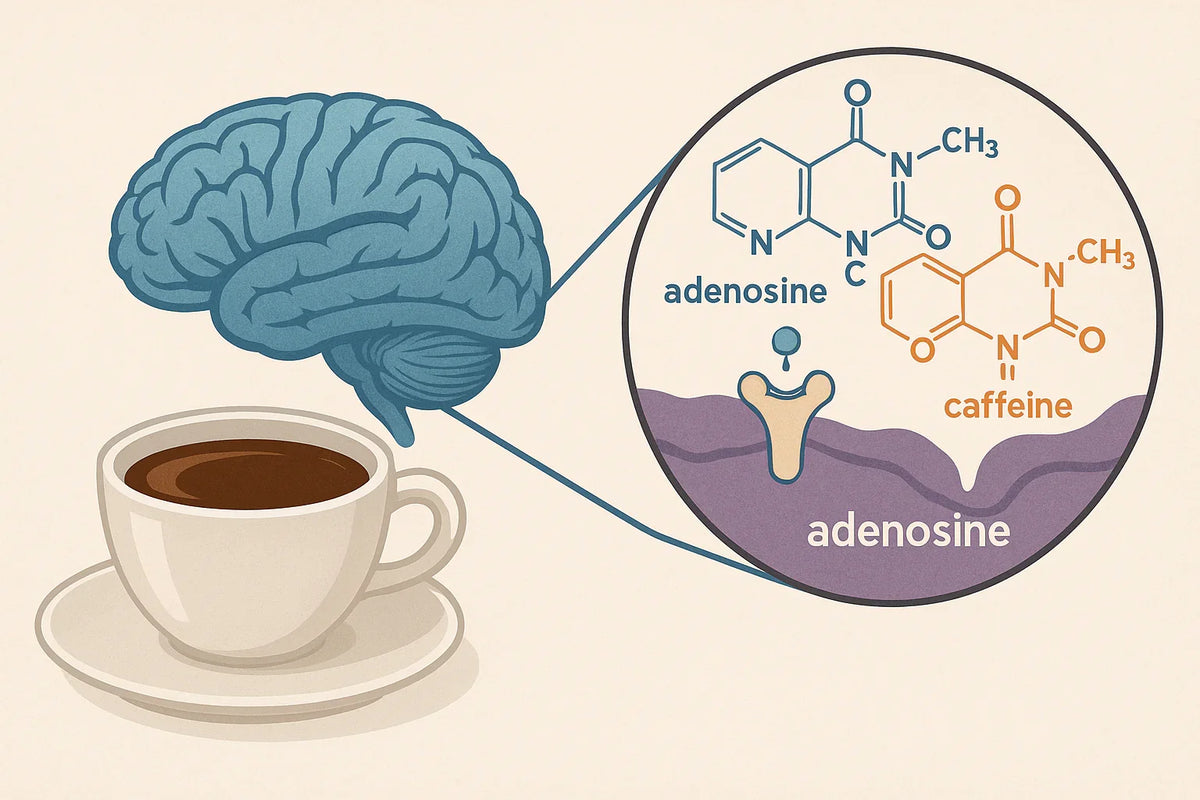
Caffeine keeps you awake mainly by blocking adenosine receptors in the brain. Adenosine helps signal the need for sleep as you remain awake. Caffeine temporarily interferes with that signal, making you feel more alert; it does not replace sleep. The NIH explains how adenosine contributes to sleep pressure.
Onset and duration of caffeine
CDC/NIOSH guidance describes an onset of roughly 15-45 minutes and a half-life around 5-6 hours. Half-life means half the dose remains, not that caffeine has disappeared. Individual clearance varies.
For illustration only, with a six-hour half-life, 200 mg at 2 p.m. becomes approximately 100 mg at 8 p.m. and 50 mg at 2 a.m. This is a simplified example, not a recommended dose or a personal prediction.
Afternoon coffee and nighttime sleep
In a 2013 placebo-controlled study, a 400 mg caffeine dose disrupted sleep even when taken six hours before bedtime. That is a substantial dose: the study does not prove that every cup has the same effect, or that six hours is sufficient for everyone. Consider both timing and quantity, rather than relying only on whether you feel stimulated.
Being able to fall asleep does not establish that caffeine had no effect: sleep duration and disruption matter too.
Individual sensitivity
The FDA notes wide differences in sensitivity and elimination. Medicines and health conditions can change your response. Ask a healthcare professional about medication interactions or persistent sleep difficulties.
Daily caffeine limits
Health Canada recommends a maximum of 400 mg daily for adults from all sources. This is not a target or a sleep-safe threshold. Lower amounts may still cause symptoms. Guidance differs for pregnancy, breastfeeding and younger people; use the relevant advice and discuss individual circumstances with your clinician. Cup size and preparation vary, so “four coffees” is not a reliable dose.
Reviewing your coffee routine
- Record when you drink coffee, the serving size and when you try to sleep.
- Include tea, energy drinks, chocolate and caffeine-containing medicines when considering your total.
- If sleep seems affected, try moving caffeine earlier or reducing the amount, and observe the pattern over several days.
- If you regularly consume caffeine, reduce it gradually: stopping suddenly can cause withdrawal symptoms such as headache and tiredness.
MedlinePlus discusses caffeine sources, effects and withdrawal.
Caffeine in decaf coffee
Yes. The FDA gives a typical range of 2-15 mg per 8-fluid-ounce cup of decaf. A lower-caffeine drink is not a guarantee of undisturbed sleep, especially for a sensitive person. Half-caf also retains caffeine; its name does not establish the exact milligrams in your cup.
For flavour-led choices, explore our decaf coffee collection and specialty decaf buying guide. Compare the process, roast and brewing method on each listing. Product availability changes, so the collection is the best place to check current options.
Reviewed October 25, 2026. General educational information, not an individual medical assessment.

