Best Specialty Decaf Coffee in Canada: A Complete Guide
“Decaf” has a branding problem.
For decades, decaf meant flat, stale, chemically stripped coffee—the kind of thing ordered apologetically, treated as a consolation prize, or brewed at 9 p.m. because caffeine was no longer an option.
That reputation is increasingly outdated.
Modern specialty decaf starts with high-quality green coffee and uses decaffeination processes designed to remove caffeine while preserving as much of the coffee’s flavour as possible. When the sourcing, processing, roasting, and brewing are all done well, decaf can be sweet, complex, balanced, and genuinely enjoyable.
If you’ve written off decaf because of what you tasted years ago, it may be worth trying again. And if you’re already looking for great decaf coffee, here’s what you need to know.
Why Decaf Got Such a Bad Reputation
The problem with traditional mass-market decaf wasn’t necessarily decaffeination alone. Often, the coffee was already at a disadvantage before the caffeine was removed.
Lower-quality coffee
Historically, many commodity decafs were produced from inexpensive green coffee selected primarily for cost and consistency rather than flavour.
If the coffee doesn’t taste particularly good before decaffeination, removing caffeine isn’t going to improve it.
Processing can affect flavour
Decaffeination requires additional processing of the green coffee. Depending on the method and how carefully it is performed, some flavour and aroma compounds can be affected along with the caffeine.
Modern specialty decaffeination processes are designed to minimize those changes.
Decaf was often treated as an afterthought
For years, decaf was frequently a low-volume product for cafés and retailers. That could mean older beans, fewer choices, and less attention paid to sourcing and roasting.
Put mediocre green coffee, additional processing, and poor freshness together and you get exactly the dull, papery cup that gave decaf its reputation.
Specialty coffee approaches the category differently: start with better coffee, use a carefully controlled decaffeination process, roast it properly, and sell it fresh.
How Specialty Coffee Is Decaffeinated
There are several decaffeination methods you’re likely to encounter when shopping for specialty coffee. Three of the most recognizable are Swiss Water, carbon dioxide (CO₂), and ethyl acetate (EA), often marketed as Sugarcane Decaf.
Swiss Water Process
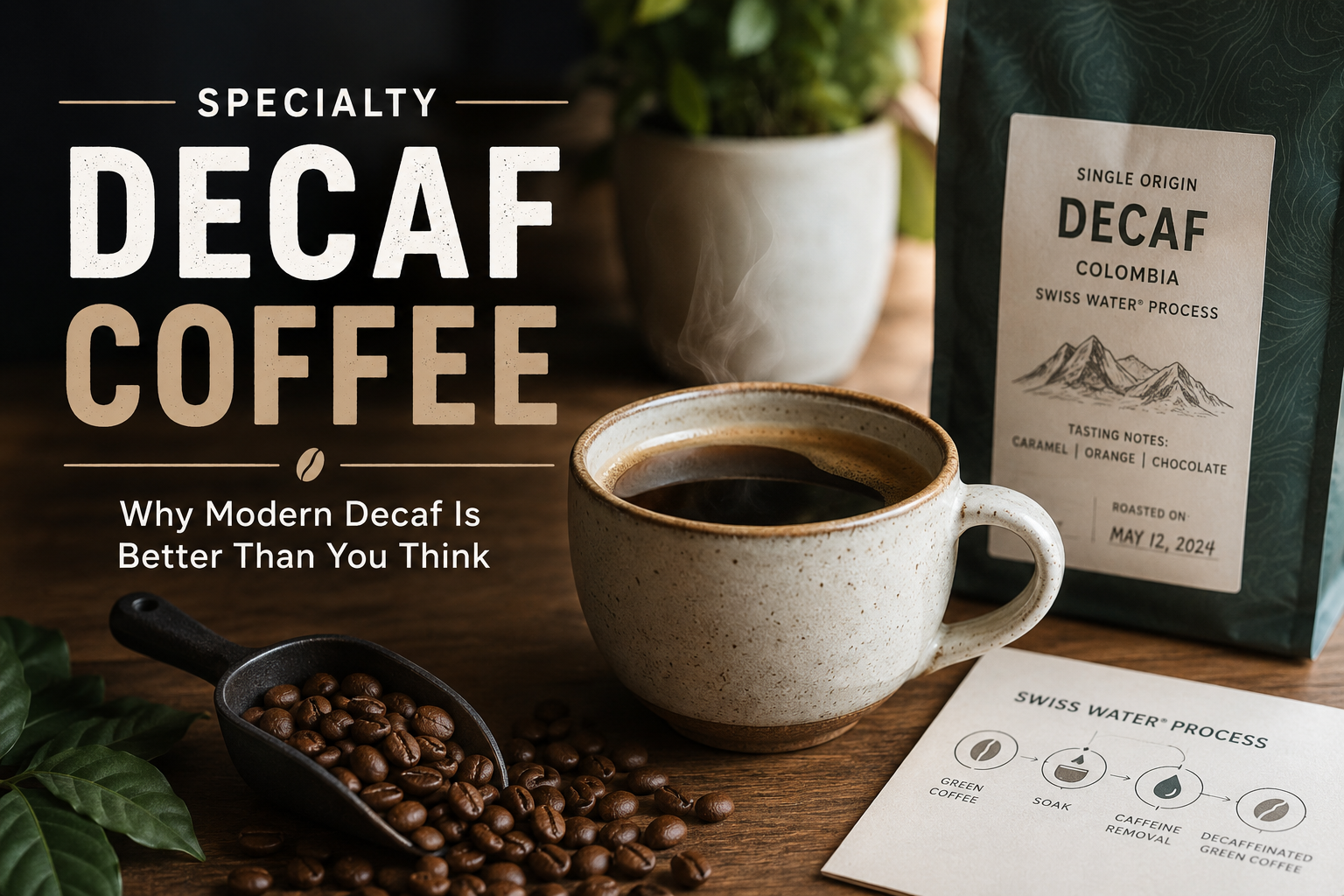
The Swiss Water Process uses water, temperature, and filtration rather than conventional chemical solvents to remove caffeine from green coffee.
The process relies on a solution known as Green Coffee Extract (GCE), which contains soluble coffee compounds. Caffeine moves out of the beans and into the solution, while carbon filtration removes caffeine from the GCE so it can continue circulating through the coffee.
The goal is to remove caffeine while retaining as much of the coffee’s original character as possible.
Despite the name, the modern commercial Swiss Water process is closely associated with Canada and is operated in British Columbia. It has become especially recognizable among North American specialty coffee drinkers.
If you see “Swiss Water Process” on a bag of decaf, this is what the roaster is referring to.
CO₂ Process
The carbon dioxide process uses CO₂ under high pressure to selectively extract caffeine from green coffee.
Under the right temperature and pressure conditions, carbon dioxide can penetrate the coffee and interact with caffeine, allowing it to be separated while limiting the removal of many compounds responsible for the coffee’s flavour.
CO₂ decaffeination requires specialized equipment and is less commonly discussed by consumers than Swiss Water or EA processing, but it can produce excellent coffee.
Sugarcane or EA Process
Sugarcane decaf is commonly associated with ethyl acetate, or EA.
Ethyl acetate is a compound that occurs naturally in various fruits and other foods, although the EA used commercially can be produced through different manufacturing routes. During decaffeination, it acts as a solvent that helps remove caffeine from the green coffee.
The method has become particularly popular for Colombian specialty coffees, and you’ll often see bags labeled “Sugarcane Decaf,” “EA Decaf,” or “Sugarcane EA.”
Well-executed EA decafs can retain impressive sweetness, body, and fruit character.
What About Methylene Chloride Decaf?
Methylene chloride is another solvent used in some decaffeination processes.
Its presence doesn’t automatically tell you whether the original coffee was high or low quality, and solvent residues in food are regulated. However, specialty roasters increasingly highlight processes such as Swiss Water, CO₂, and EA because consumers want greater transparency about how their coffee was processed.
Rather than assuming one method automatically guarantees good coffee, look at the complete picture: green-coffee quality, origin, decaffeination process, roasting, freshness, and transparency.
What to Look for When Buying Specialty Decaf
A good bag of decaf should give you much of the same information you would expect from any specialty coffee.
Look for a clearly identified decaffeination method. Swiss Water, CO₂, EA, or another named process gives you more information about how the coffee was handled.
Check for a roast date. Freshness still matters with decaf. Treat it like regular specialty coffee rather than assuming decaffeination makes it indefinitely shelf-stable.
Look for origin information. Region, producer, farm, cooperative, variety, processing method, and tasting notes are all signs that the roaster is treating the coffee as a serious product rather than an anonymous “decaf blend.”
Pay attention to the roaster. A good specialty roaster should put real effort into its decaf program. Single-origin releases and detailed sourcing information are encouraging signs, although a thoughtfully designed decaf blend can also be excellent.
Does Decaffeination Change the Flavour?
Yes, it can—but that doesn’t mean decaf has to taste bad.
Decaffeination changes the physical and chemical environment of green coffee, and the extra processing can alter how the coffee ultimately tastes and roasts. Some subtle aromatic qualities may become less pronounced.
The difference, however, depends heavily on the coffee, decaffeination method, roasting, and brewing.
A sweet, chocolatey Colombian or Brazilian coffee, for example, can translate beautifully into decaf. Coffees built around delicate floral and highly aromatic characteristics may show the effects of decaffeination more clearly.
That’s one reason origins with chocolate, caramel, nut, and ripe-fruit profiles are so common among specialty decafs: those characteristics can remain expressive after processing.
The important point is that decaffeination does not automatically make coffee bland.
What Does Decaf Taste Like by Origin?
Origin still matters after caffeine is removed.
Brazil
Brazilian coffees are often associated with chocolate, nuts, caramel, and relatively gentle acidity. Those characteristics can work extremely well in decaf, particularly for espresso and drinkers who prefer a classic coffee profile.
Colombia
Colombia is one of the most common origins for specialty decaf, particularly EA or Sugarcane-processed coffees.
Expect everything from caramel and chocolate to red fruit, citrus, and tropical fruit, depending on the region, variety, processing, and roast.
Central America
Coffees from countries such as Costa Rica, Guatemala, and Honduras can offer a great balance of sweetness, acidity, and structure. Carefully decaffeinated lots can retain plenty of clarity and character.
Ethiopia
Ethiopian decaf can be particularly interesting because the country's coffees are often prized for floral, citrus, berry, and stone-fruit aromas.
Those delicate characteristics can be challenging to preserve through additional processing, but a well-sourced and carefully roasted Ethiopian decaf can still be excellent.
How to Brew Specialty Decaf
You don’t need completely different brewing equipment or techniques for decaf. The same fundamentals apply: fresh coffee, good water, an appropriate grind, and consistent measurements.
That said, decaffeination changes the structure of green coffee, so a decaf may behave differently in the grinder and brewer than a comparable caffeinated coffee. Treat standard recipes as starting points and adjust by taste.
Espresso
Start around a 1:2 brew ratio.
For example:
18 g coffee in → 36 g espresso out
From there, adjust grind size, yield, and extraction time according to taste.
If the espresso is sour, weak, or underdeveloped, try grinding finer or increasing extraction. If it tastes harsh, dry, or excessively bitter, try grinding coarser or reducing extraction.
Pour-Over
A 1:16 coffee-to-water ratio is a useful starting point.
For example:
20 g coffee → 320 g water
Water somewhere around 90–96°C (194–205°F) is a reasonable starting range, although the ideal temperature depends on the coffee and roast level.
Then adjust grind size and technique according to taste.
French Press and Immersion Brewing
Use your normal immersion recipe as a starting point.
There is no universal decaf-specific ratio required. Grind size, steeping time, temperature, and agitation can all be adjusted just as they would with caffeinated coffee.
Grind Size
Don’t assume decaf always needs to be ground finer or coarser.
Because decaffeination affects the physical structure of the bean, a particular decaf may grind or extract differently from your usual coffee. Dial it in based on how it tastes rather than following a universal “decaf grind” rule.
How Much Caffeine Is Actually in Decaf?
Decaf is not the same thing as caffeine-free.
The overwhelming majority of caffeine is removed during decaffeination, but a small amount normally remains.
The exact amount in your cup varies considerably depending on the coffee, decaffeination process, dose, brewing method, and serving size. A cup of decaf may contain only a few milligrams of caffeine, while a regular brewed coffee can contain many times that amount.
That distinction matters if you are extremely sensitive to caffeine.
For most people who simply want to dramatically reduce their caffeine intake—particularly later in the day—decaf provides the experience of drinking coffee with substantially less caffeine.
Anyone who needs to restrict caffeine for pregnancy, medication interactions, or another medical reason should follow guidance from their healthcare professional rather than assuming that “decaf” means absolutely zero caffeine.
Who Is Specialty Decaf For?
Specialty decaf isn't just for people who have “given up” caffeine.
It makes sense for anyone who wants coffee without the full stimulant effect.
That includes afternoon and evening coffee drinkers who want another cup without consuming as much caffeine late in the day.
It can also be useful for caffeine-sensitive drinkers who enjoy coffee but dislike the jitteriness or other effects they experience from caffeine.
For people reducing their caffeine intake, decaf makes it possible to change the stimulant without necessarily giving up the ritual or flavour of coffee.
And for cafés and coffee professionals, serving genuinely good decaf means customers who don't want caffeine no longer have to accept an inferior cup.
Decaf doesn't have to be a compromise. It can simply be another category of specialty coffee.
Common Decaf Myths
“Decaf is always stale.”
It doesn't have to be.
Historically, low demand sometimes meant decaf sat around longer than regular coffee. A specialty roaster that roasts regularly and provides clear freshness information largely removes that problem.
“All decaf uses harsh chemicals.”
No.
Different decaffeination processes use very different approaches. Swiss Water relies on water and carbon filtration, CO₂ processing uses carbon dioxide under pressure, and EA processing uses ethyl acetate.
If the process matters to you, look for a roaster that clearly identifies it.
“Decaf contains absolutely no caffeine.”
Usually not.
Decaffeination removes most caffeine, but small residual amounts can remain.
“Serious coffee roasters don't bother with decaf.”
That idea is increasingly outdated.
Specialty roasters can—and do—source distinctive coffees specifically for decaffeination and roast them with the same attention given to caffeinated offerings.
Frequently Asked Questions
Is Swiss Water decaf completely caffeine-free?
No. Swiss Water removes the vast majority of caffeine, but “decaf” should not be interpreted as an absolute guarantee of zero caffeine.
Does specialty decaf cost more than regular coffee?
Sometimes.
Decaffeination adds another stage of processing and associated costs before the coffee reaches the roaster. Final retail pricing also depends on green-coffee quality, sourcing, roasting, packaging, and the roaster's overall pricing model.
Can I brew decaf the same way as regular coffee?
Yes.
Espresso, pour-over, drip, AeroPress, French press, and other common methods all work with decaf. Start with your normal recipe and dial in the coffee according to taste.
Which decaffeination method is best?
There isn't one universally superior method.
Swiss Water, CO₂, and EA can all produce excellent specialty coffee. The quality of the original green coffee and the skill of the decaffeinator and roaster matter enormously.
Instead of choosing solely by process, consider the origin, flavour profile, roast level, freshness, and roaster as well.
Why does decaf sometimes taste different from regular coffee?
Removing caffeine requires additional processing of the green beans, which can affect their physical structure and chemical composition.
That can change roasting and flavour development. With high-quality green coffee and careful processing, however, those differences don't have to translate into an inferior cup.
Which coffee origins make the best decaf?
There is no single best origin.
Brazilian and Colombian coffees are popular choices because chocolate, caramel, nut, and fruit characteristics can work extremely well after decaffeination. Central American coffees can also produce excellent decaf, while more floral origins such as Ethiopia can offer particularly distinctive cups when processed carefully.
Choose according to the flavours you enjoy rather than assuming one country is automatically superior.
How should I store decaf coffee?
Store it the same way you would any quality whole-bean coffee: sealed, dry, and protected from excessive heat, light, moisture, and oxygen.
Buy an amount you can reasonably use while it still tastes fresh, and grind immediately before brewing whenever possible.
Is decaf coffee safe during pregnancy?
Decaf generally contains far less caffeine than regular coffee, but it isn't necessarily caffeine-free. Pregnancy-related caffeine recommendations depend on individual circumstances and medical guidance.
If caffeine intake is a concern during pregnancy, follow the advice of your healthcare provider and account for caffeine from all sources.
The Bottom Line
Bad decaf exists. So does bad caffeinated coffee.
The difference today is that decaf no longer has to begin with low-quality beans, receive minimal attention, and end up forgotten on a shelf.
Specialty coffee producers, decaffeinators, and roasters have made it possible to drink decaf that is sweet, balanced, traceable, freshly roasted, and genuinely interesting.
When you're shopping, look for freshly roasted coffee, transparent origin information, a clearly identified decaffeination process, and a roaster that treats decaf as a real part of its lineup.
If your opinion of decaf was formed by a flat cup from years ago, don't judge the entire category by it.
Try a freshly roasted specialty decaf and judge the coffee in the cup.