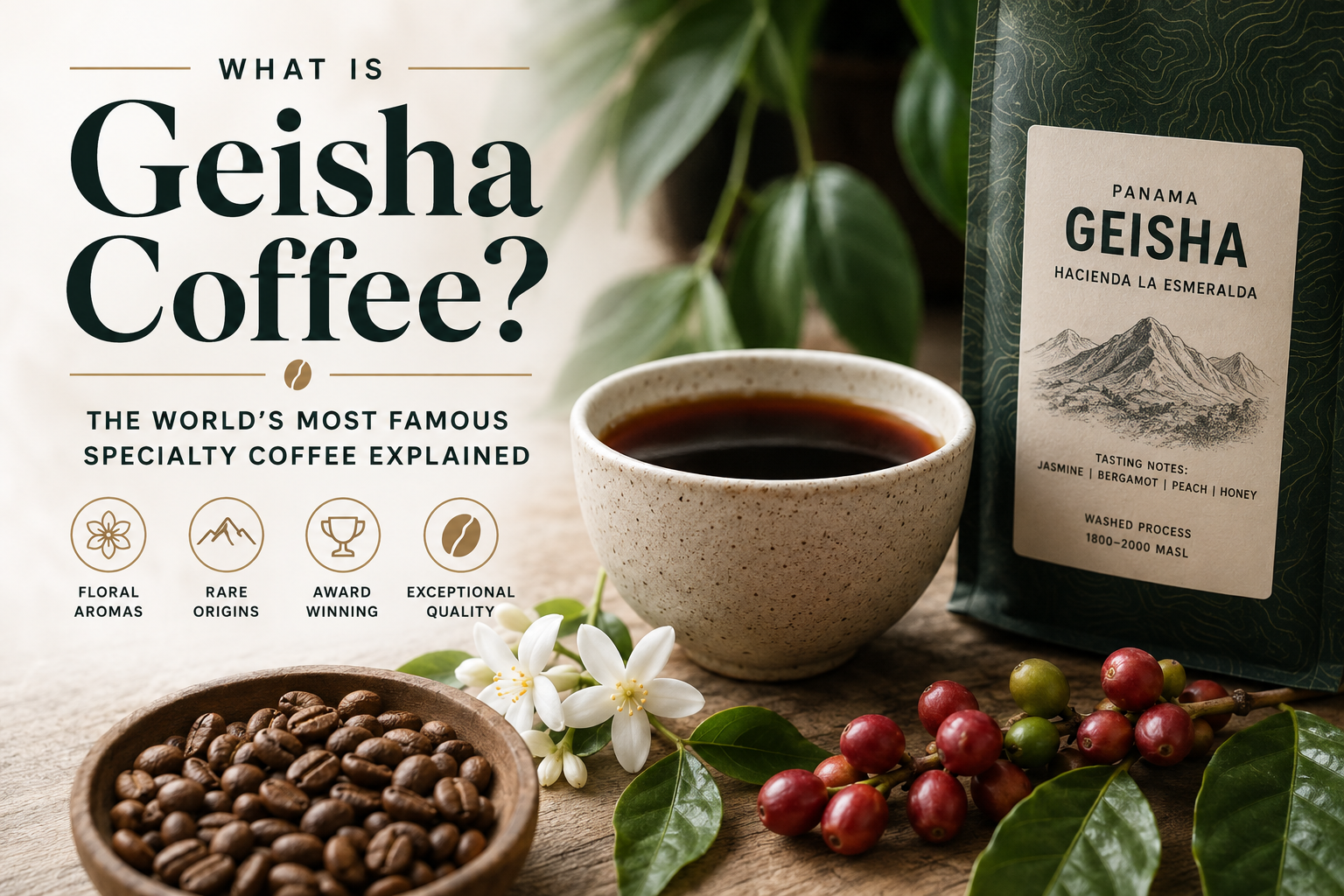
What Is Geisha Coffee? The World's Most Famous Specialty Coffee Explained
If you've explored the world of specialty coffee, you've almost certainly come across Geisha coffee, also spelled Gesha.
Known for extraordinary floral aromas, tea-like body, vibrant acidity, and some astonishing auction prices, Geisha has earned a reputation as one of the most celebrated varieties in specialty coffee.
But what exactly is Geisha coffee? Why can one bag cost $40 while another costs hundreds of dollars? Where does it come from, what does it taste like, and is it actually worth the premium?
In this guide, we'll cover everything you need to know about one of the world's most sought-after coffees.
What Is Geisha Coffee?
Geisha is a variety of Coffea arabica prized for its distinctive cup quality and aromatic complexity.
Unlike terms such as espresso, light roast, or single origin, Geisha refers to the variety of the coffee plant itself—similar to the way Pinot Noir refers to a grape variety in wine.
When grown in suitable conditions and carefully harvested, processed, and roasted, Geisha can produce remarkably expressive coffees characterized by floral aromas, fruit-forward sweetness, refined acidity, and exceptional clarity.
Its unusual sensory profile is what transformed Geisha from a relatively obscure coffee variety into one of the most prestigious names in specialty coffee.
Geisha vs. Gesha: What's the Difference?
You'll see the coffee called both Geisha and Gesha.
The variety traces its history to Ethiopia, where plant material was collected near the area commonly recorded as Gesha in the 1930s. As the variety subsequently travelled through coffee research collections and into Central America, the spelling Geisha became widely established.
Today, both spellings are used throughout the coffee industry.
Gesha is often used when emphasizing the variety's Ethiopian origins, while Geisha remains extremely common among farms, roasters, retailers, and consumers.
When you're shopping for coffee, Geisha and Gesha generally refer to the same celebrated Arabica variety.
From Ethiopia to Panama: The History of Geisha Coffee
Although Geisha's genetic roots are Ethiopian, Panama is responsible for turning it into an international specialty-coffee phenomenon.
The variety travelled from Ethiopia into research collections before eventually reaching Central America. It was introduced to Panama in the 1960s, but for decades it attracted relatively little international attention.
That changed dramatically in 2004.
A Geisha lot from Hacienda La Esmeralda was entered into Panama's prestigious Best of Panama competition and stunned judges with a flavour profile that seemed radically different from conventional expectations of Central American coffee.
The cup displayed intensely floral aromatics and characteristics reminiscent of jasmine, bergamot, tropical fruit, and tea.
Its success helped introduce Panamanian Geisha to buyers and coffee professionals around the world.
Demand quickly followed.
In the years since, Geisha has become one of the most prestigious varieties in specialty coffee, with exceptional Panamanian lots regularly commanding extraordinary prices at auction.
Why Is Geisha Coffee So Expensive?
Not every Geisha is extremely expensive, but exceptional examples can command a substantial premium.
Several factors contribute to the price.
1. Exceptional Cup Quality
The best Geishas can display aromas and flavours rarely experienced with conventional coffee varieties.
Depending on origin and processing, tasting notes may include:
-
Jasmine
-
Orange blossom
-
Bergamot
-
White peach
-
Apricot
-
Mango
-
Passion fruit
-
Lychee
-
Citrus
-
Honey
-
Cane sugar
-
Earl Grey tea
Instead of the heavier chocolate, caramel, and nut flavours many people associate with coffee, an exceptional Geisha can be intensely aromatic, delicate, and almost tea-like.
That distinctive sensory experience is one of the main reasons buyers are willing to pay a premium.
2. Limited Production
Geisha isn't necessarily the easiest variety for farmers to produce economically.
Yields can be lower than those of varieties selected specifically for high productivity, and producing exceptional Geisha requires suitable growing conditions and careful farm management.
That means less coffee may be available from a given area of farmland.
3. Demanding Growing Conditions
Geisha's most celebrated qualities tend to emerge when the variety is grown under conditions that allow its aromatic complexity to develop.
High-elevation farms with suitable climates have become particularly famous for producing exceptional Geisha.
But genetics alone aren't enough.
Soil, elevation, rainfall, temperature, shade, plant health, harvesting, and farm management all influence the quality of the final coffee.
4. Meticulous Harvesting and Processing
Premium Geisha lots may receive extraordinary attention after the cherries ripen.
Depending on the producer, this can include:
-
Selective hand-picking
-
Multiple harvest passes
-
Careful cherry sorting
-
Controlled fermentation
-
Detailed processing protocols
-
Slow, monitored drying
-
Careful storage and resting
-
Extensive quality control
For rare competition lots, even small differences in harvesting or processing can affect the final cup score and value.
5. Global Demand
Exceptional Geisha coffees are sought after by specialty roasters, competitors, collectors, cafés, and dedicated home brewers around the world.
Top lots are produced in extremely limited quantities, while global demand can be enormous.
That combination naturally pushes prices higher.
What Does Geisha Coffee Taste Like?
This is where Geisha becomes particularly interesting.
Someone expecting coffee to taste primarily like dark chocolate, roasted nuts, or caramel may be surprised by their first high-quality Geisha.
Some exceptional examples can taste closer to an intensely aromatic tea or floral infusion than a conventional cup of coffee.
Common tasting descriptors include:
-
Jasmine
-
Lavender
-
Orange blossom
-
Bergamot
-
Lemon
-
Mandarin
-
Peach
-
Apricot
-
Mango
-
Lychee
-
Strawberry
-
Passion fruit
-
Honey
-
Cane sugar
-
Black tea
-
Earl Grey
The body is often light, silky, or tea-like, while the acidity can be vibrant and highly structured.
What makes the best Geishas special isn't simply intensity. It's the combination of aromatic complexity, sweetness, clarity, acidity, and elegance.
Does Every Geisha Coffee Taste the Same?
Absolutely not.
Plant variety is only one part of what determines how a coffee tastes.
Terroir, elevation, climate, processing, fermentation, drying, roasting, and brewing can all dramatically influence the final cup.
A washed Panamanian Geisha might emphasize jasmine, citrus, bergamot, and tea-like clarity.
A naturally processed Colombian Geisha might offer much more intense tropical fruit, berries, and sweetness.
A honey-processed Costa Rican Geisha could lean toward ripe stone fruit, florals, and honey-like sweetness.
Modern producers also experiment with processing techniques such as:
-
Washed processing
-
Natural processing
-
Honey processing
-
Anaerobic fermentation
-
Extended fermentation
-
Carbonic maceration
-
Thermal-shock techniques
These processes can significantly change how the variety expresses itself.
That's why buying a Geisha based solely on the word “Geisha” doesn't guarantee a particular flavour profile.
Origin, producer, processing, roast style, and freshness still matter enormously.
Where Is the Best Geisha Coffee Grown?
Geisha is now cultivated in multiple coffee-producing countries, and exceptional examples can come from many different origins.
Panama Geisha
Panama remains the international benchmark for Geisha coffee.
The high-elevation growing regions around Boquete and Volcán have produced some of the world's most celebrated examples.
Classic Panama Geisha characteristics can include:
-
Jasmine
-
Bergamot
-
Citrus
-
Peach
-
Tropical fruit
-
Delicate sweetness
-
Tea-like body
-
Exceptional clarity
Panama is also home to many of the record-breaking Geisha lots sold through international coffee auctions.
Colombia Geisha
Colombian producers have enthusiastically embraced Geisha and are producing some remarkable coffees.
Colombian Geishas can range from elegant washed coffees to intensely processed experimental lots.
Depending on the producer and process, you might encounter:
-
Tropical fruit
-
Peach
-
Citrus
-
Florals
-
Berries
-
Candy-like sweetness
-
Bright acidity
-
Fermentation-driven fruit character
Colombia is particularly exciting for coffee drinkers interested in innovative processing.
Costa Rica Geisha
Costa Rica's high elevations and established specialty-coffee infrastructure make it another excellent environment for Geisha.
Costa Rican Geishas can be:
-
Floral
-
Clean
-
Sweet
-
Citrus-forward
-
Balanced
-
Fruit-driven
Honey processing is particularly associated with Costa Rican specialty coffee and can complement Geisha's natural sweetness beautifully.
Ethiopia Gesha
Geisha ultimately traces its genetic history back to Ethiopia.
Ethiopian coffees offer extraordinary genetic diversity, and coffees identified as Gesha can showcase intense floral and fruit characteristics.
For coffee enthusiasts interested in understanding the deeper history of the variety, Ethiopia represents an important part of the Geisha story.
Other Geisha-Producing Countries
Geisha is also grown in countries including:
-
Ecuador
-
Guatemala
-
Honduras
-
El Salvador
-
Nicaragua
-
Peru
-
Bolivia
As producers continue experimenting with terroir and processing, the range of excellent Geisha coffees continues to expand.
Is Geisha the World's Most Expensive Coffee?
Geisha is certainly responsible for some of the highest prices ever paid for specialty coffee at auction.
Exceptional Panama Geisha micro-lots have sold for extraordinary prices, particularly when they win prestigious competitions and are offered in extremely small quantities.
However, these headline-making prices shouldn't be confused with normal retail pricing.
Auction-winning Geishas represent a tiny fraction of the coffee produced.
You don't need to spend thousands of dollars to experience the variety.
Many specialty roasters offer excellent Geisha coffees at prices accessible to enthusiasts who want to experience the variety without purchasing a competition-winning micro-lot.
Is Geisha Coffee Worth the Price?
It depends on what you want from your coffee.
If you're looking primarily for a strong, familiar morning coffee with chocolate and roasted flavours, an expensive Geisha probably isn't the best value.
But if you enjoy exploring specialty coffee for flavour, origin, processing, terroir, and variety, Geisha can be an extraordinary experience.
A great Geisha demonstrates just how aromatic and complex coffee can become.
For some coffee enthusiasts, tasting an exceptional Geisha is a memorable moment because the cup can challenge their expectations of what coffee is supposed to taste like.
You don't necessarily need to buy the most expensive example available, either.
A well-grown, carefully processed, freshly roasted Geisha from Colombia, Costa Rica, Panama, or another quality origin can provide an excellent introduction to the variety.
How Should You Brew Geisha Coffee?
Because Geisha is prized for clarity and aromatics, manual filter brewing is one of the best ways to experience it.
Popular brewing methods include:
-
V60
-
Kalita Wave
-
Origami Dripper
-
Orea Brewer
-
Chemex
-
AeroPress
These methods can highlight the floral aromatics, delicate acidity, and layered fruit flavours that make Geisha distinctive.
A Simple Geisha Pour-Over Recipe
A good starting point is:
Coffee: 15 g
Water: 240–250 g
Ratio: approximately 1:16
Water temperature: around 90–94°C
Grind: medium to medium-fine
Start with a short bloom, then add the remaining water gradually in controlled pours.
The exact recipe should always be adjusted according to the coffee, roast level, grinder, and brewer.
With an expensive Geisha, it's worth making small adjustments rather than dramatically changing several variables at once.
Can You Make Geisha as Espresso?
Absolutely.
Geisha espresso can be spectacular.
It may produce intensely floral aromatics, concentrated fruit sweetness, and bright acidity.
However, espresso can also amplify acidity and intensity, while filter brewing often makes it easier to appreciate the variety's delicate aromatic complexity.
For a first experience with an expensive Geisha, many coffee enthusiasts choose pour-over.
Should Geisha Coffee Be Light Roasted?
Geisha is commonly roasted on the lighter side because excessive roast development can overwhelm the delicate characteristics that make the variety valuable.
A carefully executed light roast can preserve:
-
Floral aromatics
-
Fruit character
-
Acidity
-
Sweetness
-
Origin characteristics
-
Tea-like clarity
That doesn't mean every Geisha must be extremely lightly roasted.
The ideal roast depends on the coffee and how it will be brewed.
The goal should be to develop enough sweetness and structure while allowing the coffee's distinctive character to remain recognizable.
How Much Does Geisha Coffee Cost?
Prices vary enormously according to country, producer, farm, processing method, quality score, rarity, reputation, and lot size.
As a general retail guide in Canada, you might encounter pricing such as:
| Type of Geisha | Approximate Price (CAD) |
|---|---|
| Accessible Geisha | $30–50+ |
| Premium Geisha | $50–100+ |
| Rare micro-lot | $100–300+ |
| Competition or auction lots | Potentially hundreds or thousands of dollars |
These ranges are only general examples.
Bag size also matters enormously. A $70 bag containing 100 g of coffee is very different from a $70 bag containing 250 g.
When comparing Geisha prices, always check the weight, producer, origin, process, and lot information rather than comparing bag prices alone.
How to Choose a Good Geisha Coffee
If you're buying Geisha for the first time, don't choose solely based on price.
Look for detailed information about the coffee.
A quality specialty roaster should ideally tell you:
-
Country of origin
-
Producer or farm
-
Region
-
Variety
-
Processing method
-
Elevation when available
-
Tasting notes
-
Roast date
-
Recommended brewing style
For your first Geisha, consider choosing a coffee with tasting notes that already match flavours you enjoy.
If you love delicate florals, citrus, and tea, a washed Panama Geisha may be an excellent choice.
If you prefer intense tropical fruit and sweetness, consider a natural or experimentally processed Colombian Geisha.
How Should You Store Geisha Coffee?
Treat Geisha the same way you would any high-quality specialty coffee.
Keep the beans:
-
Sealed from excessive oxygen
-
Away from direct sunlight
-
Away from heat
-
Protected from moisture
-
Whole until you're ready to brew
Grind only what you need immediately before brewing.
For particularly expensive coffee, portioning and freezing beans in properly sealed containers can also be useful for longer-term storage.
Frequently Asked Questions About Geisha Coffee
Is Geisha coffee stronger than regular coffee?
Not necessarily.
Geisha's reputation comes from its flavour and aromatic complexity, not because it is unusually strong or highly caffeinated.
The amount of caffeine in your cup also depends heavily on dose, brewing method, extraction, and serving size.
Why is Geisha coffee so floral?
The variety's genetics can produce an unusually aromatic cup when combined with suitable growing conditions, careful processing, and appropriate roasting.
This can result in striking jasmine, orange blossom, bergamot, and tea-like characteristics.
Is Geisha coffee only from Panama?
No.
Geisha traces its history to Ethiopia and is now cultivated in many countries, including Colombia, Costa Rica, Ecuador, Guatemala, and others.
Panama is famous because it played the central role in bringing the variety to international specialty-coffee attention.
Is Geisha good for espresso?
Yes.
Geisha can produce exceptional espresso, particularly for drinkers who enjoy floral aromatics, bright acidity, and concentrated fruit sweetness.
Filter brewing remains especially popular because it can showcase the variety's clarity and delicate aromatic characteristics.
Is Gesha the same as Geisha?
In the specialty coffee market, Gesha and Geisha generally refer to the same coffee variety.
The two spellings developed through the variety's history as it travelled from Ethiopia into international coffee research and eventually Central America.
Why does some Geisha cost so much more than others?
Because the variety name alone doesn't determine quality.
Price can be influenced by:
-
Farm reputation
-
Terroir
-
Lot size
-
Cup score
-
Processing
-
Harvest quality
-
Competition results
-
Auction demand
-
Producer reputation
-
Rarity
An ordinary Geisha and a competition-winning Panama Geisha may share the same variety name while representing completely different levels of rarity and cup quality.
Discover Geisha Coffee at SpecialityCoffee.ca
At SpecialityCoffee.ca, we search for exceptional Geisha coffees from specialty roasters and producers around the world.
Because Geisha is often produced in small quantities, available coffees can change throughout the year. Depending on the season and current releases, you may find coffees from Panama, Colombia, Costa Rica, Ethiopia, and other renowned specialty-coffee origins.
Whether you're tasting Geisha for the first time or searching for a rare micro-lot, our goal is to make it easier for Canadian coffee enthusiasts to discover remarkable coffees and understand what makes each one special.
Explore our latest Geisha and Gesha coffees and experience one of the most celebrated varieties in specialty coffee.
Final Thoughts
Geisha's reputation isn't based simply on rarity or expensive auction results.
At its best, this remarkable Arabica variety can produce a cup filled with jasmine, bergamot, stone fruit, tropical fruit, honey-like sweetness, and extraordinary tea-like clarity.
Its journey from Ethiopia to Panama helped reshape modern specialty coffee and demonstrated just how diverse coffee flavour can be.
You don't need to start with a record-breaking auction lot.
Choose a freshly roasted Geisha from a reputable specialty roaster, brew it carefully, and pay attention to the aroma as the coffee cools.
You may discover a side of coffee you didn't know existed.