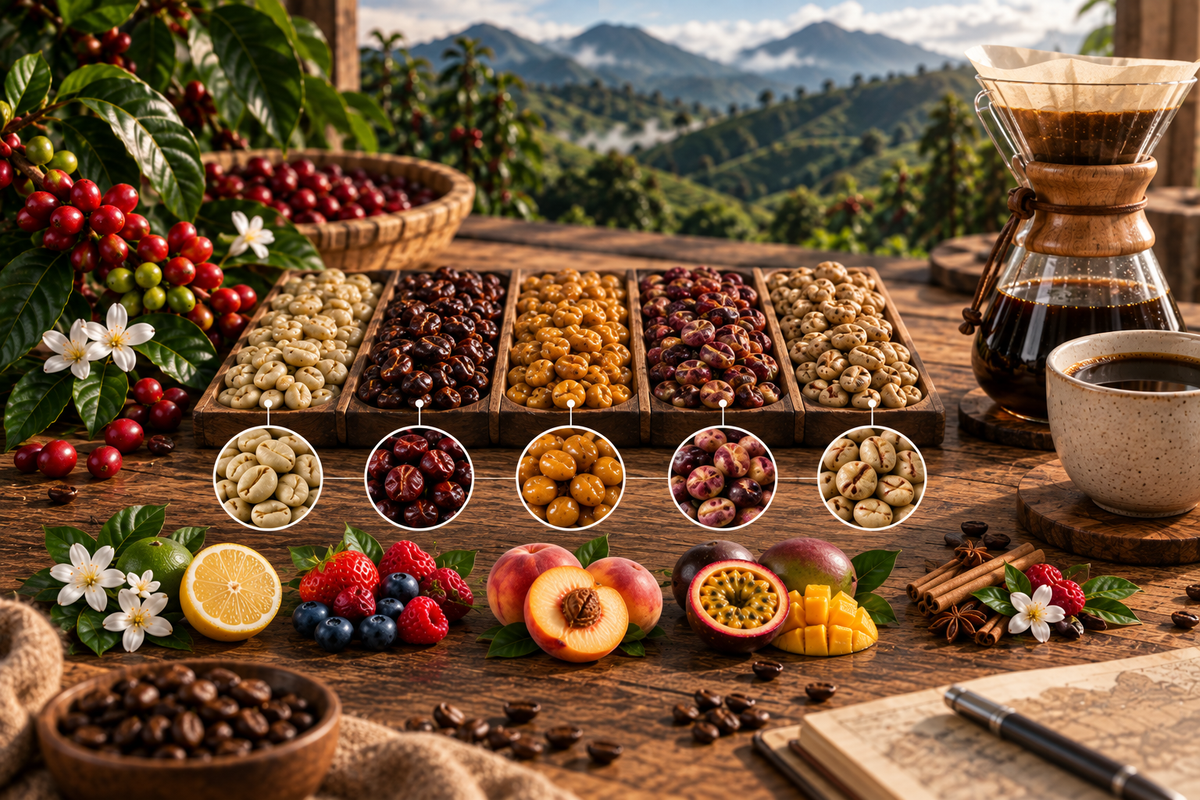
How to Read a Specialty Coffee Bag: Complete Beginner's Guide
Pink Bourbon. 1,900 MASL. Washed. Huila. Peach, jasmine, bergamot.
If you're new to specialty coffee, reading a coffee bag can sometimes feel like reading a technical specification sheet.
What is Pink Bourbon?
What does 1,900 MASL mean?
Why does the bag say peach if there isn't any peach in the coffee?
And what exactly is the difference between washed, natural, anaerobic, and co-fermented coffee?
The good news is that specialty coffee labels become much easier to understand once you know what you're looking at.
Unlike many conventional coffee packages that focus primarily on brand name and roast level, specialty coffee bags often provide detailed information about where the coffee came from, who produced it, the coffee variety, how it was processed, when it was roasted, and what you might experience when you brew it.
Each piece of information gives you another clue about the coffee inside.
Once you learn how to read those clues, choosing coffee becomes much easier.
At Speciality Coffee, we bring together coffees from specialty roasters around the world, giving you the opportunity to explore different origins, varieties, processing methods, and flavour profiles.
Browse our complete specialty coffee selection:
For more guides about coffee processing, brewing, roasting, origins, and specialty coffee culture, visit our All About Speciality Coffee Blog:
https://specialitycoffee.ca/blogs/all-about-specialty-coffee
Now let's decode the information you might find on a specialty coffee bag.
Why Do Specialty Coffee Bags Have So Much Information?
Specialty coffee places a strong emphasis on traceability.
Instead of simply telling you that you're drinking “100% Arabica coffee,” a specialty coffee label may tell you the country, region, farm, producer, variety, processing method, altitude, tasting notes, roast date, and recommended brewing style.
This information helps connect the coffee you're drinking to the place and people behind it.
But it also helps you as a consumer.
Over time, you can use the information on coffee bags to identify patterns in your preferences.
Maybe you discover that you consistently enjoy washed coffees from Ethiopia.
Maybe you become fascinated by Colombian Pink Bourbon.
Perhaps you prefer fruit-forward natural coffees.
Or maybe experimental anaerobic and co-fermented coffees are exactly what you're looking for.
Learning how to read a coffee bag allows you to move beyond simply buying coffee based on packaging or brand recognition.
You can start choosing coffee based on what you actually enjoy drinking.
1. Coffee Origin: Where Was the Coffee Grown?
One of the first pieces of information you'll usually notice is the country of origin.
You might see countries such as Colombia, Ethiopia, Kenya, Panama, Costa Rica, Rwanda, Burundi, Brazil, Guatemala, or many others.
Origin matters because coffee is an agricultural product.
Climate, geography, growing conditions, local varieties, farming practices, and processing traditions all contribute to the coffee's potential sensory profile.
However, the country name alone only tells part of the story.
Saying that a coffee comes from Colombia is useful, but Colombia is a large and geographically diverse coffee-producing country.
Two Colombian coffees can taste dramatically different.
That's why specialty coffee labels often become more specific.
2. Coffee Region: Getting More Specific
Below the country name, you may find a specific growing region.
For Colombian coffee, you might encounter names such as Huila, Nariño, or Cauca.
For Ethiopian coffee, you may see regions or producing areas such as Guji, Sidama, or Yirgacheffe.
Regional information gives you more geographic context.
As you explore specialty coffee, these names gradually become familiar.
You may eventually realize that you frequently enjoy coffees from a particular region.
But it's important not to treat regions as fixed flavour formulas.
A coffee from Huila doesn't automatically taste one particular way.
Different farms, varieties, microclimates, harvest conditions, and processing methods can produce dramatically different coffees within the same region.
Think of the region as another useful clue—not a guarantee.
3. Producer, Farm, Washing Station, or Cooperative
Some specialty coffee bags go much further than country and region.
You may find the name of an individual producer, farm, estate, washing station, or cooperative.
This is one of the most interesting aspects of specialty coffee traceability.
Instead of simply knowing that your coffee came from Colombia, you might know exactly which producer or farm was responsible for it.
In other cases, particularly where many small farmers contribute cherries to centralized processing, you may see the name of a cooperative or washing station rather than one individual farm.
These distinctions matter because coffee production systems vary considerably around the world.
The important thing is that greater traceability gives you more context about where the coffee actually came from and how it moved through the supply chain.
Over time, you may even begin recognizing producers whose coffees you particularly enjoy.
4. What Does Coffee Variety Mean?
One of the most important—and initially confusing—pieces of information on a specialty coffee bag is the coffee variety.
You might encounter names such as Gesha, Bourbon, Pink Bourbon, Typica, Caturra, SL28, Castillo, and many others.
Variety refers broadly to the genetic type of coffee plant.
Just as different grape varieties can have different characteristics, coffee varieties can differ in agronomic traits and sensory potential.
That doesn't mean variety determines flavour by itself.
Growing environment, agricultural practices, cherry ripeness, processing, fermentation, roasting, and brewing all influence what eventually reaches your cup.
But genetics establish part of the coffee's potential.
This is why variety information is so valuable when you're learning about specialty coffee.
Why Does Coffee Variety Matter?
Imagine tasting several coffees produced from the same variety across different countries and processing methods.
You may begin noticing recurring characteristics.
Then imagine tasting different varieties grown on the same farm.
You may discover surprisingly large sensory differences even though the coffees share similar growing conditions.
This is one reason coffee professionals pay so much attention to varieties.
Variety can also tell you something about the agricultural side of coffee production. Different varieties can differ in productivity, disease resistance, plant characteristics, adaptation to different environments, and cup-quality potential.
For a beginner, however, you don't need to memorize dozens of varieties.
Start by remembering the names that appear repeatedly on coffees you enjoy.
What Is Gesha Coffee?
Gesha, sometimes written Geisha, is one of the best-known varieties in modern specialty coffee.
Exceptional examples are often associated with highly aromatic profiles that may include florals, jasmine, citrus, bergamot, tea-like characteristics, and delicate fruit.
However, seeing “Gesha” on a bag doesn't guarantee that every coffee will taste the same.
Origin, growing conditions, processing, roasting, and brewing still matter enormously.
The variety gives you a clue.
It doesn't give you the entire answer.
What Is Pink Bourbon Coffee?
Pink Bourbon has become particularly visible in Colombian specialty coffee.
You may see it on coffees from regions such as Huila and other producing areas.
Depending on the coffee and processing, Pink Bourbon can produce highly aromatic and complex cups.
If you repeatedly enjoy coffees labeled Pink Bourbon, remember the name.
That's exactly how coffee-bag information becomes useful.
Instead of trying to memorize everything immediately, you gradually build a personal map of the coffees you enjoy.
5. What Does the Processing Method Mean?
After coffee cherries are harvested, they must be processed and dried before the seeds can eventually be exported and roasted.
The processing method describes important aspects of what happened during this post-harvest stage.
You may encounter terms such as Washed, Natural, Honey, Anaerobic Natural, Anaerobic Washed, or Co-Fermented.
Processing can significantly influence the sensory expression of coffee.
That's why this is one of the most useful pieces of information on the bag.
What Does Washed Mean on a Coffee Bag?
Washed coffee has most of the fruit surrounding the coffee seed removed before the coffee completes drying.
Washed coffees are often associated with high clarity, defined acidity, florals, citrus, tea-like characteristics, and precise fruit expression.
If you regularly enjoy coffees that feel clean, bright, and clearly defined, you may discover that washed coffees frequently match your preferences.
Explore our Washed Coffee Collection:
https://specialitycoffee.ca/collections/washed
What Does Natural Mean on a Coffee Bag?
Natural coffee is dried while the coffee seed remains inside the whole cherry.
This creates very different conditions from washed processing.
Natural coffees are often associated with pronounced sweetness, berries, ripe fruit, tropical characteristics, and fuller body.
Some can be wine-like or fermentation-forward, while others can remain remarkably clean and elegant.
If you enjoy fruit-forward coffee, natural processing is worth exploring.
Discover our Natural Coffee Collection:
https://specialitycoffee.ca/collections/natural
What Does Honey Process Mean?
Despite the name, honey isn't normally added to honey-process coffee.
Honey processing generally removes the outer part of the coffee cherry while leaving some sticky mucilage around the coffee seed during drying.
The resulting coffees can combine sweetness, fruit, body, and clarity in fascinating ways.
Explore our Honey Process Coffee Collection:
https://specialitycoffee.ca/collections/honey
What Does Anaerobic Mean?
Anaerobic coffee undergoes part of its fermentation under conditions where oxygen is strongly restricted, often using sealed fermentation vessels.
The technique can be combined with different broader processing approaches.
That's why you may encounter terms such as Anaerobic Natural and Anaerobic Washed.
Anaerobic coffees can range from clean and elegant to intensely fruity, wine-like, tropical, spicy, or fermentation-driven.
Explore:
https://specialitycoffee.ca/collections/anaerobic
You can also discover:
Anaerobic Natural
https://specialitycoffee.ca/collections/anaerobic-natural
and:
Anaerobic Washed
https://specialitycoffee.ca/collections/anaerobic-washed
What Does Co-Fermented Mean?
Co-fermentation generally refers to coffee fermentation involving additional fermentation inputs.
Depending on the producer and protocol, this can involve fruit, fruit-derived materials, spices, selected microorganisms, or other inputs.
These coffees can produce extraordinarily expressive sensory profiles.
You might encounter co-fermented coffees reminiscent of strawberry, peach, passion fruit, tropical candy, cinnamon, or other highly recognizable characteristics.
Because processing practices and terminology vary, transparency is especially valuable with co-fermented coffees.
Explore our Co-Fermented Coffee Collection:
https://specialitycoffee.ca/collections/co-ferment
Want to Understand Coffee Processing Better?
Processing is a large subject on its own.
If you want to understand the differences between the major methods in greater detail, read our guide:
Coffee Processing Methods Explained
https://specialitycoffee.ca/blogs/all-about-speciality-coffee/coffee-processing-methods-explained
You can also explore our detailed comparison:
Natural vs Washed vs Honey Process Coffee: The Complete Guide
Once you understand processing, coffee labels become considerably easier to decode.
6. What Does Altitude Mean on a Coffee Bag?
You may see something like:
1,800 MASL
or:
1,800–2,100 MASL
MASL means metres above sea level.
It tells you approximately how high above sea level the coffee was grown.
Altitude matters because it can influence the growing environment.
Temperature generally changes with elevation, and these environmental differences can affect how coffee cherries develop and mature.
This is one reason altitude frequently appears on specialty coffee labels.
But there is an important mistake to avoid:
Higher altitude does not automatically mean better coffee.
Is Higher-Altitude Coffee Always Better?
No.
Altitude is useful information, but it should never be treated as a universal quality score.
A coffee grown at 2,000 metres isn't automatically better than a coffee grown at 1,500 metres.
Latitude, local climate, temperature, variety, rainfall, soil, farming practices, shade, and many other environmental factors influence how coffee develops.
The same elevation can represent very different growing conditions in different parts of the world.
Think of altitude as part of the coffee's environmental context rather than a simple number where higher always means better.
7. How to Read Coffee Tasting Notes
Tasting notes are probably the most misunderstood information on a specialty coffee bag.
Imagine your coffee says:
Peach • Jasmine • Honey
Does that mean the producer added peaches, jasmine flowers, and honey?
Usually, no.
Tasting notes are generally sensory descriptors.
They communicate aromas, flavours, textures, or other characteristics that tasters associate with familiar foods, flowers, spices, beverages, or other sensory references.
The coffee may remind someone of peach.
That doesn't mean peach was added.
It may smell floral like jasmine.
That doesn't mean jasmine flowers were mixed into the coffee.
It may have a sweetness reminiscent of honey.
That doesn't mean it contains honey.
Why Can Coffee Taste Like Fruit?
Coffee is chemically complex and contains many aroma and flavour compounds.
During growing, fermentation, drying, roasting, and brewing, these compounds and their precursors contribute to the sensory experience we perceive.
Our brains then connect those aromas and flavours with things we've experienced before.
That's why someone might describe a coffee as tasting like:
peach
while another person describes the same coffee as:
apricot
Both may be identifying a similar stone-fruit character.
Tasting notes aren't necessarily a list of ingredients.
They're a language for describing sensory experience.
Are Coffee Tasting Notes Objective?
Not completely.
Sensory evaluation can be systematic, but individual perception still varies.
Your sensory memory, experience, culture, food habits, brewing method, water, grinder, and extraction can all influence what you perceive.
You don't need to taste exactly what is printed on the bag.
If the roaster says:
Peach • Jasmine • Bergamot
and you mainly taste citrus and flowers, that doesn't mean you're drinking the coffee incorrectly.
The tasting notes provide guidance.
They're not an exam.
What About Co-Fermented Coffee Tasting Notes?
This is where reading the processing information becomes especially important.
With conventionally processed coffee, a strawberry tasting note generally doesn't mean strawberries were added.
But some experimental co-fermentation techniques may intentionally involve additional fermentation inputs.
So if you see an extremely recognizable tasting note such as strawberry, passion fruit, or cinnamon alongside Co-Fermented, check the processing description.
Understanding both the tasting notes and processing method gives you much more context than looking at either one alone.
Explore:
https://specialitycoffee.ca/collections/co-ferment
8. What Does the Roast Date Mean?
The roast date tells you when the green coffee was roasted.
This is extremely useful information.
However, one of the biggest misconceptions in coffee is that the freshest possible coffee is always the best coffee.
Coffee begins releasing gases, including carbon dioxide, after roasting.
This process is commonly called degassing.
Immediately after roasting, substantial gas can remain trapped inside the coffee.
That can influence brewing.
For this reason, some specialty coffees—particularly lighter roasts—may benefit from resting before reaching their most expressive brewing window.
So if one bag was roasted yesterday and another several days ago, don't automatically assume yesterday's coffee will taste better.
How Long Should Specialty Coffee Rest?
There isn't one universal answer.
The ideal resting period depends on factors such as roast development, bean density, processing, packaging, brewing method, and the roaster's intended profile.
Some coffees become enjoyable relatively quickly.
Others, especially certain light-roasted specialty coffees, can continue opening up over a longer period.
This is why experienced coffee drinkers don't look only at whether coffee is “fresh.”
They consider how far the coffee is from its roast date and how it is developing.
If your roaster provides resting recommendations, those are usually a valuable starting point because the roaster knows how that particular coffee was developed.
Is Coffee Roasted Yesterday Better?
Not necessarily.
Very fresh coffee can sometimes be more difficult to extract consistently because of the amount of gas still being released.
With filter coffee, you may notice an especially active bloom.
With espresso, very fresh coffee can sometimes behave unpredictably during extraction.
Allowing the coffee to rest can help its brewing behaviour and sensory expression evolve.
So when reading a specialty coffee bag, think of the roast date as information for understanding the coffee's current stage—not simply a freshness competition.
9. What Does Filter Roast Mean?
Some specialty coffee bags say Filter Roast.
This generally means the roaster developed the coffee with filter brewing methods in mind.
That might include brewing methods such as V60, Kalita Wave, batch brew, or other filter approaches.
Filter roasts are often designed to emphasize clarity, aromatics, acidity, and origin character.
However, the term isn't governed by one universal roast recipe.
Different roasters have different philosophies.
A filter roast from one company may be noticeably different from a filter roast from another.
10. What Does Espresso Roast Mean?
An Espresso Roast is generally developed with espresso extraction in mind.
Because espresso uses a concentrated brewing method, roasters may adjust the roast profile to create the extraction behaviour and sensory balance they want.
That doesn't necessarily mean espresso roast must be extremely dark.
Modern specialty espresso can range from relatively light to considerably more developed depending on the roaster's style.
The words Espresso Roast are therefore better understood as an indication of brewing intention rather than a universal roast colour.
11. What Does Omniroast Mean?
Omniroast generally means the roaster intends a coffee to work across multiple brewing methods rather than producing separate filter and espresso roast profiles.
You might brew the same coffee as pour-over one day and espresso the next.
That doesn't mean every brewing method will produce identical results.
You'll still need to adjust grind size, ratio, temperature, and extraction.
But the roast profile was designed with versatility in mind.
Can You Use Filter Roast for Espresso?
Absolutely.
Filter, espresso, and omniroast labels are useful recommendations—not rigid laws.
A light filter roast can produce fascinating espresso.
An espresso-designated coffee can sometimes taste excellent as filter.
Experimentation is one of the best parts of specialty coffee.
Just remember that a coffee developed very lightly may require more attention to extraction when used for espresso.
12. What Does Roast Level Mean?
You may also see descriptions such as Light Roast, Medium Roast, or Dark Roast.
Roast level can have a significant influence on how a coffee expresses itself.
Lighter roasting generally aims to preserve more of the coffee's origin-driven and variety-driven characteristics.
Medium roasting often creates a balance between origin expression and more developed roast characteristics.
Darker roasting generally introduces stronger roast-derived characteristics and can reduce the prominence of some delicate origin attributes.
However, roast terminology isn't perfectly standardized.
One roaster's medium roast might resemble another roaster's light roast.
That is why understanding the individual roaster's style can be more useful than relying only on the words printed on the bag.
Explore our roast collections:
Light Roast
https://specialitycoffee.ca/collections/light-roast
Medium Roast
https://specialitycoffee.ca/collections/medium-roast
Dark Roast
https://specialitycoffee.ca/collections/dark-roast
13. What Does “Single Origin” Mean?
You may see Single Origin printed on specialty coffee packaging.
Broadly, this means the coffee comes from a defined origin rather than being intentionally blended from multiple unrelated origins.
But the level of specificity can vary.
A single-origin coffee could refer to one country, one region, one cooperative, one farm, or an even more specific lot depending on how the roaster uses the term.
That's why the additional information on the bag matters.
If the package identifies the producer, farm, region, variety, and processing method, you have much more context than the words “single origin” alone provide.
14. What Does “Microlot” Mean?
You may also encounter terms such as Microlot.
This generally indicates a relatively specific or separated lot of coffee, often distinguished by producer, location, variety, processing, harvest, quality, or another factor.
However, definitions and lot sizes can vary across the coffee industry.
Don't assume “microlot” automatically means better.
Instead, look at the complete information provided about the coffee.
Traceability and sensory quality matter more than a single marketing term.
What Information Matters Most on a Specialty Coffee Bag?
When you're new to specialty coffee, you don't need to analyze every detail.
Start with the information that helps you predict whether you'll enjoy the coffee.
Tasting notes give you the fastest indication of the intended sensory profile.
Processing method can tell you whether the coffee may lean toward clarity, ripe fruit, sweetness, or experimental fermentation characteristics.
Origin provides geographic context.
Variety becomes increasingly useful as you begin recognizing recurring preferences.
Roast style helps you understand how the roaster approached the coffee and whether it fits your preferred brewing style.
Roast date tells you where the coffee currently sits in its post-roast development.
Over time, all these pieces begin connecting naturally.
How to Read a Coffee Bag: A Real Example
Imagine you see this:
Colombia — Huila
Pink Bourbon
1,900 MASL
Washed
Peach • Jasmine • Bergamot
Light Roast
You can already understand quite a lot.
The coffee comes from Colombia, specifically Huila.
The variety is Pink Bourbon.
It was grown around 1,900 metres above sea level.
It underwent washed processing.
The roaster perceived characteristics reminiscent of peach, jasmine, and bergamot.
And the roast profile is relatively light.
Without even brewing the coffee, you already have clues suggesting a potentially aromatic, floral, fruit-forward, and relatively clear cup.
That's the real value of learning how to read a specialty coffee bag.
You're not predicting the flavour with absolute certainty.
You're making a much more informed choice.
How to Discover Your Coffee Preferences
The easiest method is surprisingly simple:
Pay attention to the bags of coffee you love.
Imagine you buy a coffee and think it's exceptional.
Before throwing away the bag, look at the information again.
Was it washed or natural?
What country was it from?
What variety was it?
What were the tasting notes?
Was it a light roast?
Then repeat this over several coffees.
Patterns will begin appearing.
Maybe several of your favourites are washed Ethiopian coffees.
Maybe you consistently enjoy natural coffees with berry tasting notes.
Perhaps Colombian Pink Bourbon keeps appearing among your favourites.
Or maybe you discover that experimental anaerobic coffees are exactly what excites you.
At that point, coffee labels stop looking complicated.
They become a personal buying guide.
Don't Choose Coffee Based on One Detail Alone
One of the biggest mistakes beginners can make is focusing on one impressive word.
Gesha doesn't automatically mean extraordinary.
2,000 MASL doesn't automatically mean better.
Anaerobic doesn't automatically mean more complex.
Natural doesn't automatically mean fruity.
Light Roast doesn't automatically mean high quality.
Every coffee is the result of multiple variables working together.
Use the information on the bag collectively.
Origin tells you one thing.
Variety tells you another.
Processing adds another clue.
Tasting notes help communicate the sensory direction.
Roasting influences how all of that potential is expressed.
The complete picture is much more useful than any individual word.
Frequently Asked Questions About Reading Specialty Coffee Bags
What information should I look for on a specialty coffee bag?
Start with the origin, tasting notes, processing method, coffee variety, roast style, and roast date. More traceable coffees may also provide information about the region, producer, farm, cooperative, washing station, altitude, or specific lot.
What does MASL mean on coffee?
MASL means metres above sea level. It describes the approximate elevation where the coffee was grown. Altitude can influence growing conditions, but higher altitude doesn't automatically mean higher quality.
Do coffee tasting notes mean flavours were added?
Usually not. Tasting notes generally describe aromas and flavours perceived in the coffee. A coffee described as peach, jasmine, and honey normally doesn't contain those ingredients. However, experimental processing such as some co-fermentation techniques may involve additional fermentation inputs, which is why checking the processing description is useful.
What does washed coffee mean?
Washed coffee has most of the coffee fruit removed before the seed completes drying. Washed coffees are often associated with clarity, florals, defined acidity, and precise fruit characteristics.
What does natural coffee mean?
Natural coffee is dried while the seeds remain inside the whole coffee cherries. Natural coffees are frequently associated with ripe fruit, berries, sweetness, and fuller body, although individual profiles can vary significantly.
What does coffee variety mean?
Coffee variety refers to the genetic type of coffee plant. Examples include Gesha, Bourbon, Pink Bourbon, Typica, Caturra, SL28, and Castillo. Genetics can influence both agricultural characteristics and sensory potential.
Is the freshest coffee always the best?
Not necessarily. Coffee releases gases after roasting, and some coffees benefit from resting before brewing. The ideal resting period varies depending on the coffee, roast profile, brewing method, and roaster.
What is the difference between filter roast and espresso roast?
Filter roast generally indicates that the coffee was developed with filter brewing in mind, while espresso roast indicates that the roast profile was designed primarily for espresso extraction. These aren't rigid rules, and experimenting with different brewing methods is completely possible.
The Bottom Line: How to Read a Specialty Coffee Bag
A specialty coffee bag may look complicated at first.
But you don't need to become a coffee professional to understand it.
The origin tells you where the coffee came from.
The region provides more geographic context.
The producer or farm improves traceability.
The variety tells you about the coffee's genetics.
The processing method helps explain what happened after harvest.
The altitude gives you information about the growing environment.
The tasting notes describe the sensory experience the roaster or tasters found in the coffee.
The roast date helps you understand where the coffee is in its post-roast development.
And the roast style gives you clues about how the roaster intended the coffee to be brewed and experienced.
You don't need to memorize all of this immediately.
Start with tasting notes and processing.
Then pay attention to origin and variety.
Every time you discover a coffee you love, look at the bag again.
Eventually, you'll start recognizing patterns.
You may discover that you consistently love washed Ethiopian coffees, Colombian Pink Bourbon, fruit-forward naturals, or experimental anaerobic coffees.
And that's when learning how to read a coffee bag becomes genuinely useful.
You're no longer choosing coffee randomly.
You're learning how to find coffee you actually enjoy drinking.
Explore specialty coffee from roasters around the world at:
And continue learning through our All About Speciality Coffee Blog:
https://specialitycoffee.ca/blogs/all-about-specialty-coffee