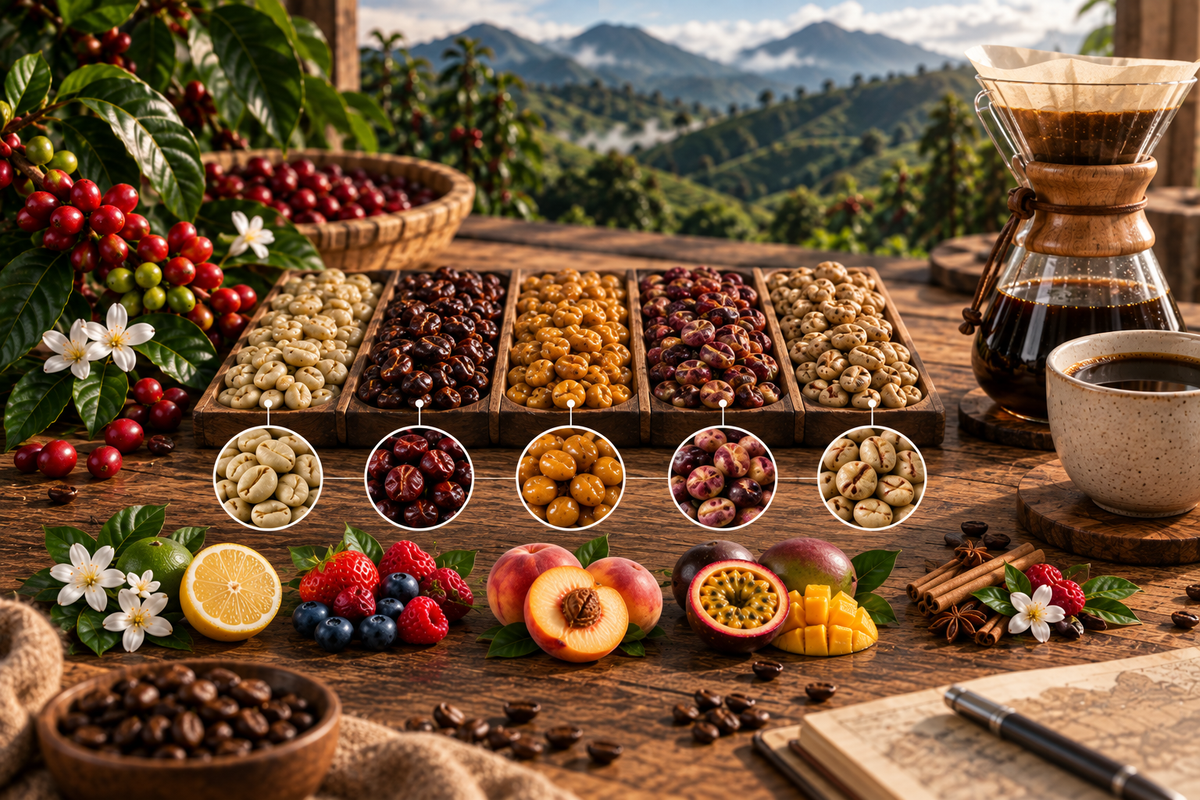
What Is Co-Fermented Coffee? Processing, Flavor & the Debate Explained
You brew a coffee labeled “strawberry co-ferment.”
The aroma is intensely reminiscent of fresh strawberries.
The flavour is so expressive that you start wondering:
How can coffee possibly taste like this?
Welcome to one of the most fascinating—and debated—areas of modern specialty coffee:
co-fermented coffee.
As coffee producers experiment with fermentation, microbial cultures, fruits, spices, and other processing inputs, a new generation of coffees has emerged with sensory profiles that can be dramatically different from traditionally washed or natural coffees.
Some taste intensely like strawberry.
Others might remind you of peach, watermelon, passion fruit, cinnamon, tropical candy, or wine.
But what exactly does co-fermented coffee mean?
Is fruit actually added to the coffee?
Is co-fermented coffee simply flavored coffee?
And why has it generated so much discussion within specialty coffee?
At Speciality Coffee, you can explore coffees produced using these innovative processing approaches through our Co-Fermented Coffee Collection:
https://specialitycoffee.ca/collections/co-ferment
You can also browse our complete specialty coffee selection:
And continue learning about coffee processing, fermentation, roasting, brewing, and origins through our All About Speciality Coffee Blog:
https://specialitycoffee.ca/blogs/all-about-specialty-coffee
Let's explore what co-fermented coffee actually is, why it can taste so intense, and why transparency matters.
What Does Co-Fermented Coffee Mean?
Co-fermentation generally refers to coffee fermentation in which the coffee is processed alongside additional fermentation inputs.
Depending on the producer and the technique, these inputs may include:
-
fruits;
-
fruit pulp;
-
fruit juice;
-
spices;
-
herbs;
-
selected yeasts;
-
microbial cultures;
-
other fermentation materials.
However, there is an important complication:
“Co-fermented coffee” is not one universally standardized processing protocol.
Different producers may use the term to describe different techniques.
One producer might ferment coffee cherries alongside fresh fruit.
Another might use fruit pulp.
Another may inoculate fermentation with selected microorganisms.
Another may combine several processing variables.
That's why the words co-fermented alone don't tell you everything about how a coffee was produced.
The producer's processing information matters.
How Is Co-Fermented Coffee Made?
There is no single recipe for co-fermented coffee.
However, a simplified process may look like this.
1. Coffee Cherries Are Harvested
As with other specialty coffee processing methods, the process begins with harvested coffee cherries.
Careful producers may sort the cherries to remove underripe, damaged, or defective fruit.
Cherry quality remains important.
Experimental processing cannot magically transform poor raw material into exceptional coffee.
2. The Coffee Enters a Fermentation Stage
Whole cherries, depulped coffee, or coffee with mucilage may be placed into a fermentation vessel.
The exact form depends on the producer's processing protocol.
3. Additional Fermentation Inputs May Be Introduced
This is where some co-fermentation techniques become distinctive.
Depending on the process, additional materials may be introduced into the fermentation environment.
These could include fruit, fruit pulp, spices, yeasts, microbial cultures, or other materials.
4. Fermentation Is Controlled
Producers may monitor variables such as:
-
time;
-
temperature;
-
pH;
-
oxygen availability;
-
pressure;
-
microbial activity.
The exact level of control varies considerably between producers.
5. The Coffee Is Dried and Prepared for Export
After fermentation, the coffee may continue through a natural, washed, honey, or another producer-specific processing system.
It is eventually dried, milled, sorted, exported, and roasted.
This means co-fermentation can exist alongside other processing terminology.
A coffee label might therefore contain several pieces of information describing different stages of its processing.
Why Is It Called Co-Fermentation?
The prefix “co-” essentially communicates the idea of fermentation occurring together with something else.
But specialty coffee terminology is evolving quickly.
There is currently considerable diversity in how producers, exporters, importers, roasters, and coffee professionals describe experimental processing.
That's why transparency is more useful than relying on a single processing word.
Instead of knowing only:
“Co-Fermented”
it can be useful to know:
What was added?
At what stage?
How long was fermentation?
Was the coffee fermented as whole cherry or depulped?
What happened after fermentation?
The more information available, the better consumers can understand what they're drinking.
What Does Co-Fermented Coffee Taste Like?
There is no universal co-fermented flavour.
However, these coffees can produce some extraordinarily expressive sensory profiles.
Depending on the coffee and processing technique, you may encounter flavours reminiscent of:
-
strawberry;
-
raspberry;
-
watermelon;
-
peach;
-
passion fruit;
-
mango;
-
pineapple;
-
citrus;
-
cinnamon;
-
spices;
-
tropical candy;
-
wine;
-
floral aromas;
-
ripe fruit.
Some coffees can taste surprisingly close to the ingredient referenced in their processing.
A strawberry co-ferment, for example, may present an unusually recognizable strawberry-like aroma.
A cinnamon-influenced fermentation may produce an intensely spice-forward profile.
But the exact sensory outcome depends on much more than the added material.
Coffee variety, terroir, cherry ripeness, microorganisms, fermentation conditions, drying, roasting, and brewing all influence the final cup.
Explore some of these unconventional profiles in our Co-Fermented Coffee Collection:
https://specialitycoffee.ca/collections/co-ferment
Why Can Co-Fermented Coffee Taste So Intense?
Coffee fermentation is a complex biological and chemical process.
Microorganisms consume available nutrients and produce metabolites during fermentation.
Some fermentation-derived compounds or their effects can persist through subsequent processing and influence the sensory characteristics of the coffee.
When producers change the fermentation environment—or introduce additional substrates, microorganisms, or other inputs—they may alter that biochemical environment.
The resulting coffee can therefore develop a sensory profile that is dramatically different from a conventionally processed coffee.
This doesn't mean every added ingredient transfers its flavour directly and predictably into the coffee bean.
The reality is more complicated.
Fermentation involves interactions between:
-
microorganisms;
-
sugars;
-
acids;
-
temperature;
-
oxygen;
-
time;
-
coffee chemistry;
-
additional fermentation materials.
That's why co-fermentation is better understood as a processing intervention rather than simply “put fruit in a tank and the coffee tastes like fruit.”
Is Co-Fermented Coffee Flavored Coffee?
This is where things become particularly interesting.
The answer depends partly on what we mean by flavored coffee.
Traditional flavored coffee usually involves applying flavouring substances to coffee—often after roasting.
Think of products marketed as:
-
vanilla coffee;
-
hazelnut coffee;
-
caramel coffee;
-
chocolate-flavored coffee.
Co-fermentation happens much earlier.
It takes place during post-harvest coffee processing, typically at or near origin and before drying, export, and roasting.
So the two practices are not identical.
However, that distinction doesn't eliminate the debate.
If an external ingredient is intentionally introduced during processing and contributes significantly to the final sensory profile, some coffee professionals question how that coffee should be categorized and described.
That is why disclosure is so important.
Consumers should be able to distinguish between a coffee whose strawberry-like characteristics emerged from conventional coffee processing and one processed with additional strawberry-related inputs.
Co-Fermented Coffee vs Traditional Flavored Coffee
Here's a simplified comparison:
| Characteristic | Co-Fermented Coffee | Traditional Flavored Coffee |
|---|---|---|
| Stage | During post-harvest processing | Commonly after roasting |
| Location | Usually at or near origin | Often at roasting/manufacturing stage |
| Process | Fermentation intervention | Flavor application |
| Added inputs | May include fruits, spices, cultures or other materials | Flavoring compounds |
| Final flavour | Influenced through processing and fermentation | Intentionally flavored after processing/roasting |
| Transparency | Processing disclosure is especially important | Usually sold explicitly as flavored coffee |
The distinction is meaningful.
But it shouldn't be used to hide the fact that additional ingredients may have been introduced during processing.
Clear labeling helps consumers understand exactly what they're buying.
Are Co-Fermented Coffee Tasting Notes Real?
Yes—but the more useful question is:
Where did those sensory characteristics come from?
Coffee naturally contains an extraordinary range of sensory attributes.
The World Coffee Research Sensory Lexicon identifies 110 flavor, aroma, and texture attributes that can be used to describe coffee.
Coffee can naturally remind us of:
-
berries;
-
citrus;
-
florals;
-
chocolate;
-
nuts;
-
spices;
-
tropical fruit;
-
caramel;
-
tea;
-
many other foods and aromas.
A conventionally processed Ethiopian coffee, for example, can naturally remind a drinker of strawberry or blueberry without those fruits ever touching the coffee.
That's completely different from saying that strawberries were physically added.
With co-fermented coffee, additional processing inputs may contribute to or influence the sensory outcome.
Therefore, a tasting note can be genuine while the origin of that sensory characteristic is different.
That's an important distinction.
Tasting Notes vs Added Ingredients
Imagine two coffees.
Coffee A
Tasting notes: Strawberry, jasmine, peach.
No strawberries, jasmine, or peaches were introduced during processing.
These words simply describe sensory characteristics perceived in the coffee.
Coffee B
Tasting notes: Strawberry, tropical fruit, candy.
The producer fermented the coffee using strawberry or strawberry-derived material as part of the processing protocol.
Both coffees can genuinely remind you of strawberry.
But they reached that sensory experience through different pathways.
This is exactly why processing transparency matters.
Does Co-Fermented Mean Fruit Was Added?
Not always.
This is an important distinction.
The term can be used broadly, and experimental fermentation terminology isn't perfectly standardized across the coffee industry.
Some co-ferments clearly involve fruits or spices.
Other fermentation protocols may use selected yeasts, microbial cultures, or other fermentation inputs.
So you shouldn't automatically assume:
Co-fermented = fruit added.
Instead, check the processing information supplied by the producer or roaster.
Ideally, that description should tell you what was introduced and how the coffee was processed.
Co-Fermentation vs Anaerobic Fermentation
These terms are also frequently confused.
They describe different aspects of coffee processing.
Anaerobic fermentation refers primarily to the fermentation environment—specifically fermentation under strongly restricted oxygen conditions.
Co-fermentation generally refers to fermentation involving coffee alongside additional fermentation inputs.
Therefore, a coffee could theoretically involve both.
For example, a producer could ferment coffee in a sealed, oxygen-restricted environment while also introducing another fermentation input.
In that case, simply calling the coffee “anaerobic” wouldn't necessarily communicate the entire processing story.
If you want to explore coffees fermented under restricted-oxygen conditions, visit our Anaerobic Coffee Collection:
https://specialitycoffee.ca/collections/anaerobic
And for co-fermented coffees:
https://specialitycoffee.ca/collections/co-ferment
Co-Fermented Coffee vs Natural Coffee
Natural coffee is processed by drying coffee with the cherry intact before the dried fruit is removed.
The natural process itself doesn't require external fruits, spices, or flavouring materials to be added.
A natural Ethiopian coffee can naturally produce intense strawberry, blueberry, or tropical fruit characteristics.
A co-fermented coffee may use additional fermentation inputs to influence its sensory profile.
These are fundamentally different processing concepts.
However, they can overlap.
A coffee could undergo a co-fermentation stage and subsequently be dried using a natural process.
That's another reason processing terminology can become complicated.
Co-Fermented Coffee vs Washed Coffee
Washed processing generally removes the coffee fruit relatively early before the seed completes drying.
Washed coffees are often associated with:
-
high clarity;
-
defined acidity;
-
floral characteristics;
-
precise fruit;
-
transparent origin expression.
Co-fermented coffee can produce much more intense fermentation-influenced sensory characteristics depending on the processing protocol.
But again, the categories don't always exist in complete isolation.
Experimental fermentation can be incorporated into broader washed, natural, or other processing systems.
Why Is Co-Fermented Coffee Controversial?
Co-fermented coffee sits at the intersection of several important questions in modern specialty coffee.
These include:
-
innovation;
-
producer autonomy;
-
terroir;
-
transparency;
-
sensory evaluation;
-
competition rules;
-
consumer expectations;
-
coffee identity.
Some coffee professionals view experimental fermentation as an exciting opportunity for producers to innovate and create new sensory experiences.
Others worry that external ingredients can make it difficult to determine how much of a coffee's flavour comes from:
-
variety;
-
terroir;
-
traditional processing;
-
fermentation;
-
added inputs.
There are also questions about how these coffees should be presented during sensory evaluation and competition.
The debate isn't simply about whether the coffee tastes good.
It's also about how the coffee is described and understood.
Why Transparency Matters
Imagine buying a coffee with extremely strong strawberry flavour.
The bag tells you:
Strawberry – Raspberry – Candy
But it doesn't mention that strawberry material was introduced during fermentation.
You might reasonably assume those characteristics emerged entirely from the coffee's variety, terroir, and conventional processing.
Now imagine the label instead explains:
Co-fermented with strawberry
You immediately have additional context for interpreting the cup.
That doesn't automatically make the coffee better or worse.
It simply gives you more information.
In modern specialty coffee, processing itself can be an important part of a coffee's value and identity.
Transparency allows consumers to decide what they value.
Does Co-Fermentation Hide Terroir?
Potentially—but this isn't a simple yes-or-no question.
Highly expressive fermentation inputs can become dominant in the cup.
If strawberry, cinnamon, or tropical fruit characteristics become extremely intense, subtle differences related to terroir or variety may become harder to identify.
That is one reason some specialty coffee professionals prefer minimally interventionist processing.
They want the cup to emphasize:
-
origin;
-
producer;
-
variety;
-
terroir;
-
traditional processing.
Others argue that processing itself is part of the producer's craft.
From this perspective, producers should have freedom to experiment with fermentation techniques that can increase differentiation and potentially create additional value.
These represent different philosophies about coffee.
They don't necessarily require one universal answer.
Is Co-Fermented Coffee Specialty Coffee?
Co-fermented coffee can absolutely be made from high-quality coffee and can offer distinctive sensory attributes.
Modern definitions of specialty coffee increasingly recognize that value can come from multiple attributes—including sensory characteristics and information about origin, producer, growing practices, and processing.
What matters particularly with experimental processing is accurate communication.
If additional ingredients or fermentation inputs played an important role in creating the sensory experience, providing that information helps buyers, roasters, baristas, and consumers understand the coffee.
Is Co-Fermented Coffee Better?
Not automatically.
Just as:
Anaerobic doesn't automatically mean better.
Natural doesn't automatically mean better.
Washed doesn't automatically mean better.
Co-fermented doesn't automatically mean better.
Processing is one component of coffee quality.
An exceptional co-ferment requires more than an unusual ingredient.
The original coffee still matters.
So do:
-
cherry quality;
-
variety;
-
farming;
-
harvesting;
-
fermentation management;
-
drying;
-
storage;
-
roasting;
-
brewing.
A spectacular processing technique cannot completely replace high-quality raw material and careful production.
Why Are Coffee Producers Experimenting With Co-Fermentation?
Modern specialty coffee rewards differentiation.
Producers compete in a global market where distinctive coffees can attract attention from importers, roasters, competitors, baristas, and consumers.
Processing innovation gives producers another tool for creating value.
Traditionally, coffee differentiation has focused heavily on:
-
origin;
-
farm;
-
altitude;
-
variety;
-
terroir;
-
processing method.
Fermentation adds another layer.
By controlling fermentation or introducing additional inputs, producers may create sensory profiles that stand out dramatically.
For some producers, that can represent an opportunity to experiment and potentially access new markets.
Why Are Co-Fermented Coffees Becoming Popular?
The answer is simple:
They can be extremely memorable.
A coffee that tastes intensely reminiscent of strawberry candy or passion fruit can completely change someone's expectations of what coffee can taste like.
That surprise creates interest.
It also works particularly well in a specialty coffee culture where consumers increasingly want to explore:
-
rare varieties;
-
unusual origins;
-
experimental processing;
-
fermentation;
-
distinctive sensory profiles.
Co-fermented coffee fits naturally into that exploratory side of specialty coffee.
Explore our current selection:
https://specialitycoffee.ca/collections/co-ferment
Does Co-Fermented Coffee Always Taste Funky?
No.
Like anaerobic coffee, co-fermented coffee exists across a wide sensory spectrum.
Some coffees can be:
-
clean;
-
elegant;
-
floral;
-
delicately fruity.
Others can be:
-
intensely tropical;
-
candy-like;
-
wine-like;
-
highly fermented;
-
unconventional.
The final result depends on the coffee and the processing protocol.
So don't assume every co-fermented coffee will taste overwhelmingly fermented.
How Should You Brew Co-Fermented Coffee?
There is no universal recipe specifically for co-fermented coffee.
The best brewing method depends on:
-
roast level;
-
coffee density;
-
variety;
-
processing;
-
grinder;
-
water;
-
desired flavour profile.
However, because co-fermented coffees can be extremely aromatic, filter brewing can be a fascinating way to explore them.
Methods such as:
-
V60;
-
Kalita Wave;
-
flat-bottom drippers;
-
AeroPress;
-
batch brew;
can allow you to experience aromatic complexity and flavour changes as the coffee cools.
Co-Fermented Coffee for Pour-Over
Pour-over can work particularly well for highly expressive coffees.
Paper filtration can help create a relatively clear cup, allowing individual sensory characteristics to become easier to distinguish.
When drinking a co-ferment, pay attention to how the flavour changes with temperature.
When hot, you may notice florals and acidity.
As the cup cools, fruit characteristics may become much more obvious.
Some highly expressive coffees reveal their most interesting flavours only after cooling considerably.
Drink slowly.
Co-Fermented Coffee for Espresso
Co-fermented coffee can also create extraordinarily expressive espresso.
Because espresso concentrates flavour, fruit and fermentation characteristics can become especially intense.
Depending on the coffee, an espresso might remind you of:
-
strawberry;
-
raspberry;
-
tropical fruit;
-
peach;
-
candy;
-
wine;
-
spices.
However, highly processed light-roast coffees can require careful dialing in.
Extraction matters enormously.
How to Taste Co-Fermented Coffee
When trying a co-ferment for the first time, don't immediately decide whether you like it.
Taste carefully.
Consider:
Aroma
What do you smell before tasting?
Fruit character
Does it remind you of berries, tropical fruit, stone fruit, or citrus?
Sweetness
Does the coffee feel candy-like, jammy, honey-like, or more subtle?
Acidity
Is it bright, soft, wine-like, or fruit-driven?
Fermentation character
Do you notice wine, ripe fruit, or unusual fermented aromas?
Body
Does the coffee feel light, creamy, syrupy, or heavy?
Aftertaste
Which flavours remain after swallowing?
Then allow the coffee to cool and taste again.
You may be surprised by how dramatically it changes.
The Best Way to Understand Co-Fermented Coffee
Comparison is one of the most useful ways to learn.
Try comparing:
Washed vs Co-Fermented
or:
Natural vs Co-Fermented
or, if possible:
the same producer, variety, or farm processed using different methods.
Keep your brewing method as consistent as possible.
Then compare:
-
aroma;
-
fruit intensity;
-
sweetness;
-
acidity;
-
clarity;
-
fermentation character;
-
body;
-
aftertaste.
This allows you to experience processing rather than simply reading about it.
Who Should Try Co-Fermented Coffee?
Co-fermented coffee is particularly interesting for adventurous coffee drinkers.
You may enjoy it if tasting notes such as these sound exciting:
Strawberry
Watermelon
Peach
Passion Fruit
Mango
Tropical Candy
Cinnamon
Wine-like Fruit
Intense Florals
If that sounds like your kind of coffee, explore our Co-Fermented Coffee Collection:
https://specialitycoffee.ca/collections/co-ferment
Who Might Prefer Traditional Coffee Processing?
Co-ferments aren't necessarily for everyone.
If your favourite coffees emphasize:
-
subtle florals;
-
delicate acidity;
-
transparent terroir;
-
traditional washed profiles;
-
restrained fermentation;
you may prefer conventionally washed or natural coffees.
And that's perfectly reasonable.
Co-fermented coffee doesn't need to replace traditional processing.
It simply expands the range of sensory experiences available within modern specialty coffee.
Co-Fermented Coffee and the Future of Specialty Coffee
Coffee processing continues to evolve.
Producers are experimenting with:
-
fermentation environments;
-
selected microorganisms;
-
fermentation duration;
-
temperature;
-
oxygen;
-
additional substrates;
-
drying techniques;
-
combinations of processing methods.
As experimentation increases, terminology and transparency will become increasingly important.
Consumers need enough information to distinguish between coffees whose sensory characteristics primarily emerge through conventional processing and coffees where additional processing inputs play an important role.
That doesn't mean innovation should stop.
Quite the opposite.
Innovation becomes more meaningful when consumers understand what was actually done.
Explore Co-Fermented Coffee in Canada
Co-fermentation represents one of the most adventurous sides of contemporary specialty coffee.
These coffees can challenge your expectations with intense fruit, sweetness, spices, florals, and fermentation-driven complexity.
If you're ready to explore them, browse our Co-Fermented Coffee Collection:
https://specialitycoffee.ca/collections/co-ferment
You can also explore our complete specialty coffee selection:
And continue learning about processing, fermentation, origins, roasting, and brewing through our All About Speciality Coffee Blog:
https://specialitycoffee.ca/blogs/all-about-specialty-coffee
Frequently Asked Questions About Co-Fermented Coffee
What is co-fermented coffee?
Co-fermented coffee generally refers to coffee that undergoes fermentation alongside additional fermentation inputs. Depending on the producer, these may include fruits, spices, selected microorganisms, or other materials. Because terminology isn't completely standardized, the producer's processing description is important.
Is co-fermented coffee flavored coffee?
Not in exactly the same way as traditional flavored coffee. Conventional flavored coffee commonly has flavorings applied at a later stage, often after roasting. Co-fermentation happens during post-harvest processing. However, when additional ingredients are intentionally used during fermentation, transparent disclosure is important.
Is fruit added to co-fermented coffee?
Sometimes. Some co-fermentation techniques use fruits, fruit pulp, juice, spices, or other ingredients. Others may focus on microbial or fermentation inputs. The exact method varies by producer.
Why does co-fermented coffee taste so fruity?
Fermentation can influence the compounds that contribute to coffee aroma and flavour. When producers alter the fermentation environment or introduce additional inputs, the resulting sensory profile can become unusually expressive.
What is the difference between co-fermented and anaerobic coffee?
Anaerobic describes fermentation under strongly restricted-oxygen conditions. Co-fermentation generally refers to fermenting coffee alongside additional inputs. A processing protocol could potentially involve both techniques.
Are tasting notes in co-fermented coffee real?
Yes. Tasting notes describe what a coffee reminds the drinker of. However, it is useful to know whether a sensory characteristic developed without additional ingredients or whether related materials were intentionally introduced during processing.
Is co-fermented coffee specialty coffee?
Co-fermented coffees can be high-quality specialty coffees with distinctive sensory characteristics. Accurate information about processing and added inputs helps consumers understand what makes the coffee distinctive.
Is co-fermented coffee better than washed or natural coffee?
Not inherently. Co-fermented, washed, natural, honey, and other processing approaches create different sensory experiences. Coffee quality depends on the raw material, producer expertise, processing, drying, roasting, and brewing—not simply the processing label.
The Bottom Line: What Is Co-Fermented Coffee?
So, what is co-fermented coffee?
In general, it refers to coffee whose fermentation involves additional fermentation inputs, which may include fruits, spices, selected microorganisms, or other materials depending on the producer.
The result can be extraordinary.
You might encounter coffees reminiscent of:
strawberry, watermelon, peach, passion fruit, tropical candy, cinnamon, florals, or wine.
But co-fermentation also raises important questions about transparency.
A conventionally processed coffee that naturally tastes like strawberry and a coffee fermented with strawberry-related inputs are not the same thing.
Both can be delicious.
Both can be fascinating.
But consumers should be able to understand what they're drinking and why it tastes the way it does.
Co-fermented coffee doesn't need to replace washed, natural, honey, or traditional fermentation.
Think of it as another branch of an increasingly diverse specialty coffee world.
The important question isn't whether co-fermentation is universally “good” or “bad.”
It's whether the process is clearly communicated—and whether you enjoy the cup.
Ready to discover this experimental side of coffee?
Explore our Co-Fermented Coffee Collection:
https://specialitycoffee.ca/collections/co-ferment
Browse all specialty coffee:
And continue exploring the world of specialty coffee:
https://specialitycoffee.ca/blogs/all-about-specialty-coffee