

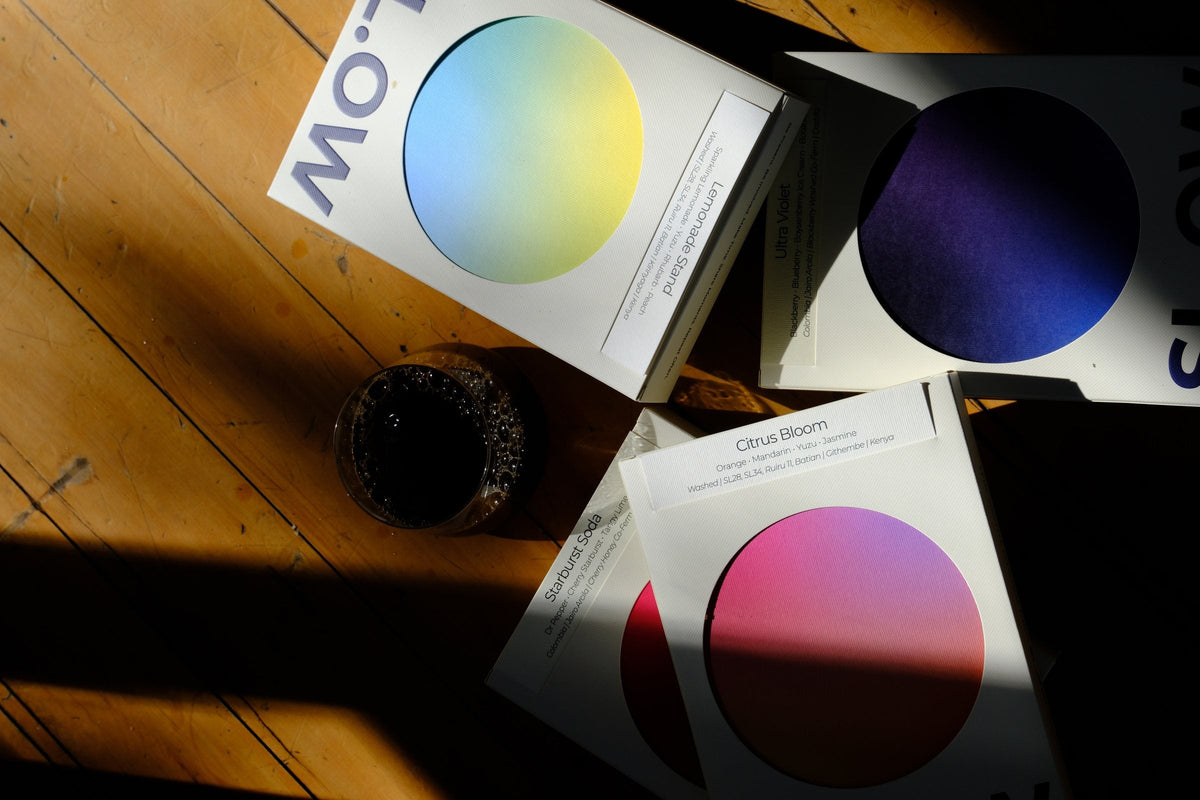
SL.OW Coffee Roasters, from a Cambridge garage to a New Zealand coffee ritual
Before there was a box of coffee called Blue Bonbon, there was a one-kilo roaster in a garage in Cambridge, New Zealand. The people feeding it green coffee in 2022 were Sam Dakin, an Olympic track cyclist, and his flatmate Alex King, a member of New Zealand’s national waterski team. Spend enough of your working life trying to take fractions of a second off the clock and the name they chose for their roastery starts to make sense. They called it SL.OW.
Today a box from Slow Coffee Roasters might lead you to a washed Typica from the Peruvian Andes, a chocolatey espresso blend or a Colombian Gesha that smells of bergamot. To understand how all three belong on the same shelf, it helps to start with the person who wanted a few quiet minutes to make a cup.
Sam Dakin and the road to Cambridge
Dakin grew up in Auckland. He tried road cycling, mountain biking and triathlon before finding his event on the track. After school he moved to Cambridge, in the Waikato region of New Zealand’s North Island, to join the national high-performance cycling programme. Sprinting would take him to two Olympic Games. It also gave him an unusual education in cafés. Wherever a race or training block took him, he kept finding cyclists gathered around a coffee table. A different city might mean a different language, a different espresso and an entirely familiar way to spend an hour. Dakin on cycling and cafés · New Zealand Olympic Team biography
Dakin has spoken publicly about living with obsessive-compulsive disorder and the place that small rituals have in his own life. Making coffee gave him an ordinary, repeatable reason to pause. In his journal he describes a favourite version of that moment: filter coffee in hand, listening to rain. It says something about the founder that his idea of a memorable cup leaves room for the sound outside the window. It also explains why the brand name is printed big enough for the person making breakfast to read it. Dakin says he sometimes needs the reminder himself. Sam’s public journal · His interview with The Mental Game
What came out of the garage
Dakin and King began roasting small batches on a Bullet in the garage of their shared home. A March 2024 account from their New Zealand collaborator On the Grind captures the business at a particularly interesting size. The garage still served for small single-origin batches, packing and dispatch. When an order called for more capacity, Grey St Roasting Co made its Loring S15 available. Customers ordering at the time could be drinking coffee from the two friends’ original setup even as the pair learnt to reproduce their work on a larger machine. On the Grind’s early profile of SL.OW
There is a thread from those days to the range you can buy in Canada. The early profile describes light to medium roasting, with the character of the green coffee guiding the choice. Look at the collection now and you can see what that means in practice. A delicate Gesha gets a light filter roast. Two Ethiopian naturals get a little more development for espresso. The house blend has the depth to carry through steamed milk. Choosing a SL.OW coffee by how you make it at home already tells you more than choosing by the colour of the box.
Jonte Wright and the names on the boxes
Jonte Wright joined as a director in early 2025. An elite rower with years of training at Lake Karāpiro, Wright came to specialty coffee through a home espresso machine. His first attempts to brew filter beans in it went badly enough to send him looking for a different setup. He bought a hand grinder, paper filters and a V60. One brew barely drained, the next ran through too quickly, and then he made a light, fruity cup that justified the whole exercise. It is easy to see why someone with that introduction might want to make the first purchase a little easier for the next person.
Wright had also designed clothing. At SL.OW he brought that experience to a website rebuild, typography and a new monogram. The most telling design decision is one you can see without knowing anything about design. You can read “Mango Arango” and already have a sense of whether you want a cup. Turn to the lot information and there is a grower, Arturo Arango, whose surname you now have a reason to remember. The name makes an introduction. The farm and variety give you somewhere to go next. Wright’s account of joining SL.OW
What SL.OW means by clarity
In an interview with The Magic Roast, Dakin described a buying preference that helps explain the line-up. He and Wright want a coffee’s distinctive flavour to be easy to find, and they want it to hold up when different people brew it. Clarity can be a subtle floral aroma you recognise immediately. It can equally be the unmistakable chocolate and hazelnut of a morning espresso. If you are new to fruit-forward coffee, this gives you a useful way to read the tasting notes. Pick one familiar flavour, then see whether it turns up in the aroma, the first sip or the finish. Dakin’s interview with The Magic Roast
From a flat white to a fruit-forward espresso
Studio Blend is where to begin if your first coffee of the day comes with milk. A natural Brazilian component from Cerrado gives it weight. Washed Colombian coffee from Tolima brings lift to the finish. SL.OW can change the components as harvests turn while keeping the milk chocolate, hazelnut and brown sugar that regulars come back for. The roaster suggests a double at a 1:2 ratio in 28 to 32 seconds. With an 18 g basket, that means 36 g in the cup. Taste the espresso before adding milk and see how the nutty middle gives way to toffee in a flat white. SL.OW’s Studio Blend recipe
For espresso with more fruit, Apricot Affair and Disco Biscuit make a good pair. Both are naturally processed Ethiopian coffees roasted medium-light for espresso. Apricot Affair comes through the Muje Mesina station in East Guji, where whole cherries dry on shaded beds. Its apricot preserve, pear and almond suggest a fruit tart. Disco Biscuit comes from smallholders around Hube in Sidamo. Think strawberry dipped in chocolate, followed by the warm spice of a hot cross bun. If you usually take a cappuccino, make both with the same amount of milk. The almond in the first and the chocolate in the second give you two quite different breakfasts.
Two Colombian farms, one unusual variety
Of all the filter coffees in our selection, Mango Arango and Tropical Thunder are the pair we would put on the table together. Both are natural Yellow Sudan Rume coffees from Quindío, Colombia. Both lots spent about 45 hours fermenting in contact with air before drying on raised beds. A label that stopped at country, variety and process would make them sound almost interchangeable.
Arturo Arango grows Mango Arango at El Paraíso. Its mango and vanilla cream give the impression of a smoothie, with starfruit and lemon appearing towards the finish. Jairo Arcila grows Tropical Thunder at Santa Monica. Here the fruit runs to passionfruit and pink guava, with spiced rum and lavender in the aroma. Use the same grinder setting and water for both, pour a little of each into separate cups and return to them as they cool. Which has the creamier texture? Which leaves a longer floral impression? That comparison shows how much information a farm name adds to a coffee label, even when several of the technical details match.
Two other Colombian releases take you in different directions. Peach Petal is Felipe Arcila’s Red Gesha from Jardines del Encanto. Grown around 1,900 metres and packed in 100 g boxes, it is the one to choose for peach, poached pear and the bergamot aroma you might recognise from Earl Grey. Passionfruit Escape comes from Caturra grown by smallholders around El Indio in Planadas, Tolima. Its orange-and-chocolate note is described as “Jaffa” on the box. If your taste runs to raspberry, passionfruit and cacao nibs, this is the brighter, punchier choice.
Three ways to explore filter coffee beyond Colombia
Witch’s Toffee is a washed Typica grown by Alex Barrantes at Querofinca, his family farm in Cajamarca, Peru. Baked apple, toffee and a little lime make it a particularly good introduction for someone who enjoys caramel sweetness in filter coffee. Pour it next to Mango Arango and notice the different kinds of sweetness: one recalls the browned edges of apple pastry, the other ripe tropical fruit.
For Ethiopian filter coffee, Blue Bonbon comes from Gargari Gutity station in Gedeb. Its “Supernatural” designation refers to the way the whole cherries dry, in thicker layers with less direct sun and airflow. The blue-raspberry candy note is a description of the cup. Look for a sharper redcurrant flavour behind it and a floral lift as the coffee loses heat. Strawberries and Cream offers another route through Ethiopia. At Urabeast station in Guji, cherries from Suke and Tobutu undergo a kombucha-inspired fermentation during natural processing. The result is closer to ripe strawberry and vanilla, with a small lemon accent. For a first tasting, choose Blue Bonbon for tartness or Strawberries and Cream for a rounder fruit impression.
When to open the bag and how to brew the first cup
SL.OW recommends resting its beans for at least two weeks from the roast date. Its espresso guidance puts the usual sweet spot at two to four weeks, while some light filter lots keep developing out to eight weeks. For a Canadian drinker opening coffee roasted in New Zealand, the roast date is a more useful reference than the day the parcel arrived. Keep the whole beans sealed, cool and dry. If you are opening two boxes for a comparison, freezing small airtight portions lets you return to the pairing later. SL.OW’s coffee care guide
For a filter starting point, the roaster’s V60 guide pairs 15 g of coffee with roughly 250 g of water at 96 °C. Use a cup large enough to swirl, and save a few sips for when it is comfortably warm. For a first SL.OW order, our picks would be Studio Blend for the flat-white drinker, Witch’s Toffee for a sweet daily filter, and the two Yellow Sudan Rumes for anyone who enjoys tasting coffees side by side. The seasonal lots change. You can find the coffees we currently carry in Canada in our SL.OW Coffee Roasters collection.

